
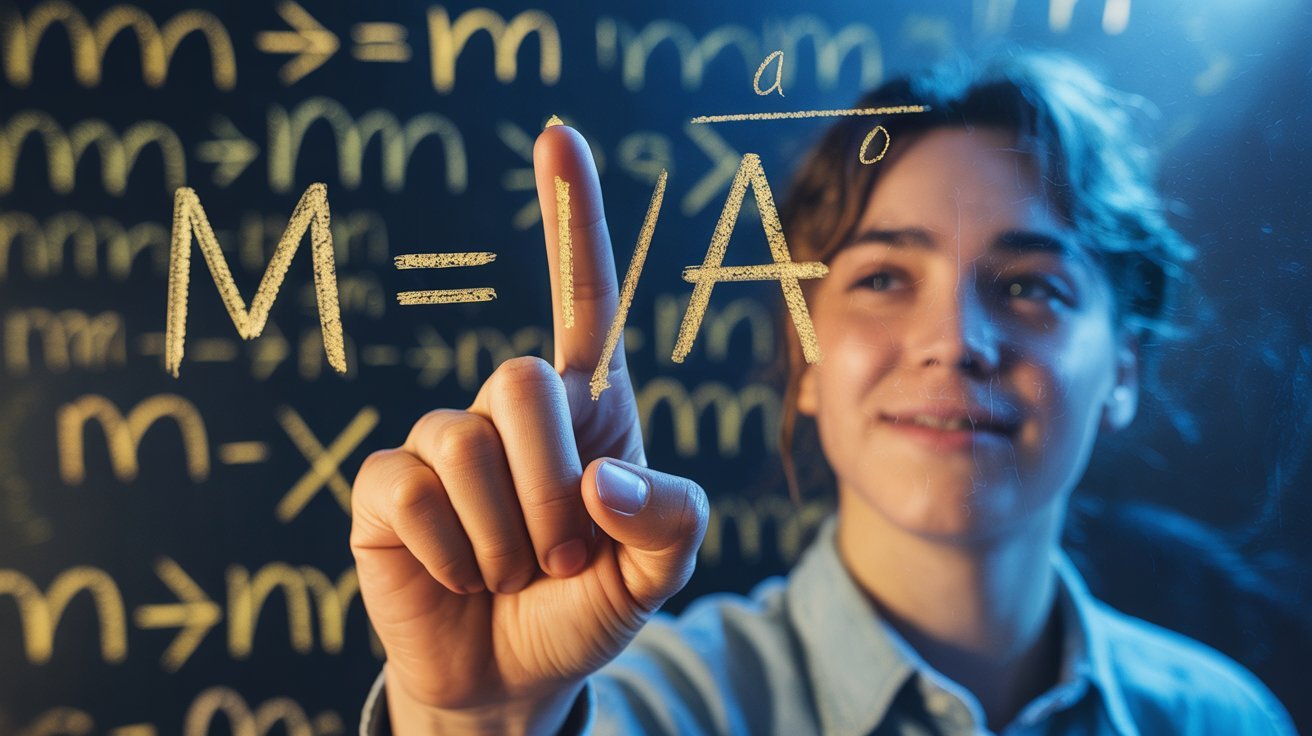
The Zero-Fear Guide: Finally Understand the GCSE Biology Magnification Equation (Even If You Hate Maths!)
Let’s be honest: are you one of those brilliant GCSE Biology students whose brain just freezes the moment a math symbol appears? You pour your heart into understanding mitosis and ecology, only to panic over a tiny equation. You’re not alone. That dreaded magnification equation is arguably the number one source of dropped marks on the exam—not because the arithmetic is hard, but because the strange units and the tricky rearranging feel like a cruel trap.
This isn’t another dry textbook chapter. This is your personal, guaranteed, zero-fear path to solving every magnification question correctly. We’re going to transform that moment of math panic into a feeling of absolute, quiet mastery that translates directly into a guaranteed mark on your paper. Forget the anxiety. Let’s unlock the simplest, yet most feared, equation in your entire biology syllabus.
The Equation Unlocked: Why It’s Really Just Simple Division 🔬
Think about the goal: you’re using a microscope to make something tiny look huge. The GCSE Biology magnification equation simply calculates how many times bigger the image you see (or draw) is compared to the specimen’s true, microscopic size. It’s nothing more than a simple ratio.
The Core Formula: Image Size / Actual Size—Simplified
You need this formula etched into your memory, but let’s understand the meaning behind the symbols first:
$$\text{Magnification} = \frac{\text{Image Size}}{\text{Actual Size}}$$
The Magnification Equation in GCSE Biology simply tells you the ratio of the drawing or photograph’s size (Image Size) to the specimen’s actual size (Actual Size). Magnification = Image Size / Actual Size (M = I / A). This formula applies to all exam boards.
These three core numbers are your friends:
- Magnification (M): How much bigger it looks. It has no units, just an $\times$ (e.g., $\times 400$).
- Image Size (I): This is the length of the drawing or the photograph provided on the exam paper.
- Actual Size (A): The actual, true, and incredibly tiny size of the specimen under the lens.
The Units Nightmare! Your Secret Weapon Against Conversion Mistakes
Here lies the true challenge, the moment when the brightest students mess up: the units. In the exam, the Image Size will be in millimeters ($\text{mm}$), while the Actual Size will be in tiny micrometers ($\mu\text{m}$). You absolutely cannot divide them until they speak the same unit language.
Here’s the one rule that simplifies everything and guarantees you get the right answer:
| Unit | The Connection You Must Know | The Action to Take |
| $\text{Millimeter}$ ($\text{mm}$) | $1 \text{ mm} = 1000 \mu\text{m}$ | $\times 1000$ |
The Zero-Mistake Strategy: Always take the millimeters ($\text{mm}$) measurement and multiply it by 1000 to convert it into micrometers ($\mu\text{m}$). This keeps your numbers positive and your head clear. For example, a drawing of $8 \text{ mm}$ becomes $8000 \mu\text{m}$.
Real-World Exam Scenarios: Three Steps to Mastery
The key to overcoming fear of loss is seeing the questions solved step-by-step. We’re going to work through the three ways the examiner will try to trick you.
1. Calculating Magnification: The Straightforward Shot
Question: A sketch of an onion cell is $75 \text{ mm}$ long. The actual length of the cell is known to be $15 \mu\text{m}$. What is the magnification?
| Step | Action | The “Why” |
| 1. Unit Conversion | $75 \text{ mm} \times 1000 = 75,000 \mu\text{m}$ | Non-negotiable: Match $\text{mm}$ to $\mu\text{m}$. |
| 2. Apply Formula | $\text{Magnification} = 75,000 \mu\text{m} / 15 \mu\text{m}$ | $\text{Image Size}$ (big) $\div$ $\text{Actual Size}$ (small) |
| 3. Final Answer | $\text{Magnification} = 5000$ | Always state the answer as $\times 5000$ or $\text{5000x}$. |
2. Rearranging for Actual Size: The Tricky One Solved
This question separates the students who understand the formula from those who just memorized it. This is where most math anxiety kicks in, but watch how simple it is:
Question: A microscope operates at a magnification of $\times 4000$. The image it produces measures $80 \text{ mm}$. What is the actual size of the cell in $\mu\text{m}$?
| Step | Action | The “Why” |
| 1. Unit Conversion | $80 \text{ mm} \times 1000 = 80,000 \mu\text{m}$ | Get the units aligned first. |
| 2. Apply Rearranged Formula | $\text{Actual Size} = \text{Image Size} / \text{Magnification}$ | $80,000 \mu\text{m} / 4000$ |
| 3. Final Answer | $\text{Actual Size} = 20 \mu\text{m}$ | The result is a microscopic size, so $\mu\text{m}$ is the natural unit. |
3. Solving for Image Size: The Reverse Calculation
Question: A bacterium has an actual size of $5 \mu\text{m}$. It is viewed with $\times 10,000$ magnification. What would the image size be in $\text{mm}$?
| Step | Action | The “Why” |
| 1. Calculate $\text{Image Size}$ | $\text{Image Size} = \text{Magnification} \times \text{Actual Size}$ | $10,000 \times 5 \mu\text{m} = 50,000 \mu\text{m}$ |
| 2. Final Unit Conversion | $50,000 \mu\text{m} / 1000 = 50 \text{ mm}$ | Crucial: The question asks for $\text{mm}$, so convert back. |
| 3. Final Answer | $\text{Image Size} = 50 \text{ mm}$ | A drawing size is usually in $\text{mm}$ or $\text{cm}$. |
Your Anxiety-Free Tool: The T-Triangle Method
You don’t need to be a human calculator; you need a tool to quickly navigate the formula. This T-Triangle is the secret weapon of the confident biology student, eliminating the mental gymnastics of rearranging.
- Imagine a triangle divided into three.
- I (Image Size) always goes on the top.
- M (Magnification) and A (Actual Size) sit side-by-side on the bottom.
- Want I? Cover the I. You’re left with $M \times A$.
- Want M? Cover the M. You’re left with $I / A$.
- Want A? Cover the A. You’re left with $I / M$.
It’s simple, visual, and instantly removes the most common source of confusion.
What are the biggest mistakes students like me make? (The Voice of the Reader)
This is about protecting your hard-earned marks. Watch out for these three pitfalls:
- 1. The Unit Trap: Dividing $10 \text{ mm}$ by $50 \mu\text{m}$ without converting. Your answer will be $1000 \times$ too small. Always check those units first!
- 2. Forgetting the $x$: If you calculate a magnification of $3000$, the examiner wants to see $\times 3000$ or $\text{3000x}$. It’s a tiny detail, but it matters.
- 3. The Calculator Rush: Take one extra second to write down your converted numbers. Don’t rush the steps. Showing your conversion (e.g., “$15 \text{ mm} \rightarrow 15000 \mu\text{m}$”) can often secure a partial mark even if your final division is wrong.
Resources
You’ve moved past the fear and achieved mastery. Now, sustain it. Here is the best resource to keep your knowledge sharp:

Leave a Reply