
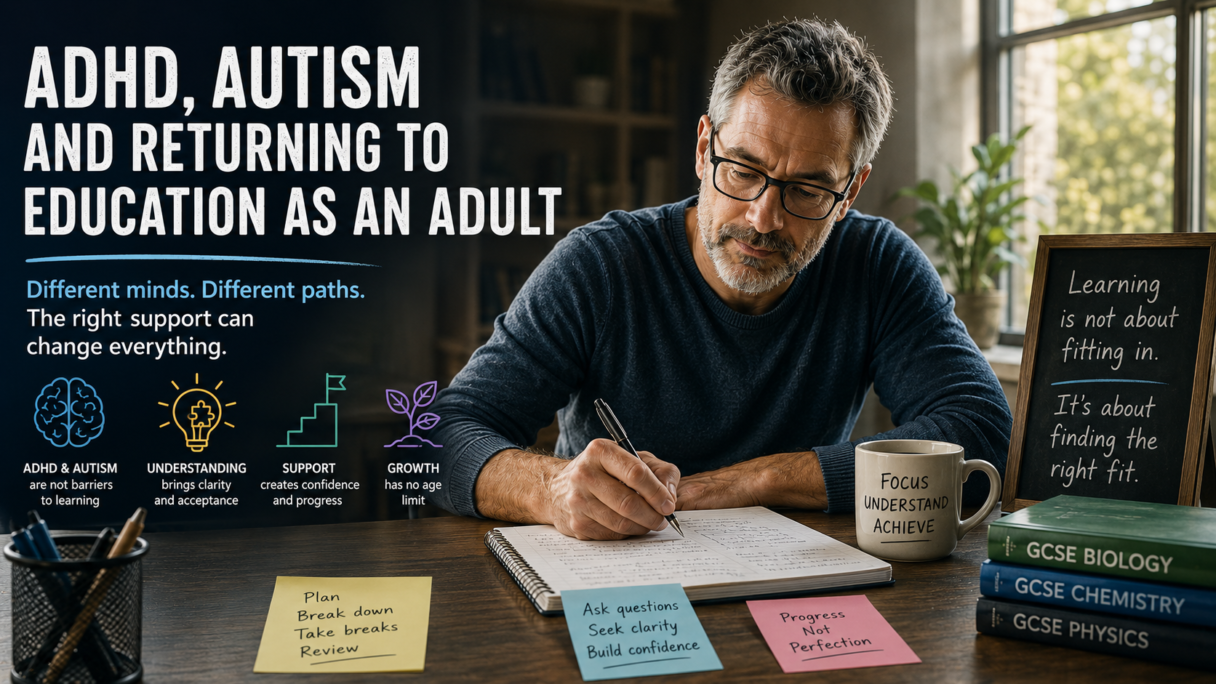
ADHD, Autism and Returning to Education as an Adult
There comes a pivotal time in many people’s lives when events from years ago suddenly begin to make sense.
Perhaps it happens after a conversation with a friend. Perhaps it follows a diagnosis received in adulthood. Sometimes it comes from watching a son or daughter go through school and recognising familiar patterns in their experiences. Behaviours that once seemed confusing, frustrating or even embarrassing begin to fit together like pieces of a puzzle that has been sitting unfinished for years.
For many adults, that moment arrives through a growing understanding of ADHD or autism.
It is not unusual for people to reach their thirties, forties or even later before beginning to understand that the difficulties they experienced at school may not have reflected a lack of intelligence, effort or ability at all. Instead, they begin to realise that they were trying to learn within a system that often struggled to accommodate different ways of thinking.
That realisation can be both liberating and unsettling.
On the one hand, it explains experiences that may have remained unanswered for decades. On the other, it naturally raises an uncomfortable question.
What might have been different if somebody had understood earlier?
There is, of course, no way of answering that question with certainty. The past cannot be rewritten. Yet the future remains remarkably open, and for many adults that future includes something they never expected… returning to education.
The School Experience Many Adults Still Carry
One of the most remarkable aspects of teaching is discovering just how vividly people remember school.
Adults who have not sat in a classroom for twenty or thirty years can often recall particular lessons, teachers or examination results with surprising clarity. These memories rarely concern the details of Biology or Physics. Instead, they revolve around how education made them feel.
Some remember feeling permanently behind everyone else.
Others remember understanding the subject perfectly well but finding it impossible to concentrate in a busy classroom. Some recall becoming overwhelmed by noise, constant interruptions or rapidly changing activities. Others describe spending enormous amounts of energy simply trying to appear as though they were coping.
Many blamed themselves.
At the time, few people spoke openly about neurodiversity. ADHD was frequently misunderstood. Autism was often viewed through a far narrower lens than it is today. Many learners simply passed through education carrying labels such as lazy, disruptive, careless, inattentive or lacking effort.
Those labels can become surprisingly persistent.
Years later, adults often continue to describe themselves using words first applied during childhood, despite everything they have achieved since leaving school.
Returning to Education with a Different Perspective
One of the advantages of adulthood is perspective.
School is no longer the centre of your world. Success is no longer measured solely by examination grades or comparison with classmates. Adult learners generally arrive with a clearer understanding of why they are studying and what they hope to achieve.
Some are preparing for careers in nursing or healthcare.
Others need GCSE Science to access university or professional qualifications.
Many are simply driven by curiosity or a desire to challenge assumptions they have carried about themselves for years.
This motivation changes everything.
Learning becomes purposeful rather than compulsory. Questions are asked because understanding matters, not because there will be a test next week. Progress is measured against personal goals rather than somebody else’s expectations.
For adults with ADHD or autism, this shift in perspective can transform the entire educational experience.
Learning Should Fit the Learner
Perhaps the greatest lesson I have taken from education is that no two people learn in exactly the same way.
This may sound obvious, yet traditional education often struggles to reflect that reality. Classrooms are built around timetables, shared objectives and practical constraints that inevitably require compromise. Teachers work incredibly hard within those systems, but the system itself cannot always adapt to every individual.
One-to-one tuition offers something different.
Instead of expecting the learner to adapt to a predetermined pace, the lesson adapts to the learner.
If a topic requires more time, there is time available.
If visual explanations work better than written notes, lessons can reflect that.
If discussion helps understanding, discussion becomes part of the learning process.
If regular breaks improve concentration, they become entirely normal rather than something that feels unusual.
The objective is not to teach in one particular way.
The objective is to discover how each individual learns most effectively.
Confidence Is Not Built Through Pressure
Many adults returning to education carry more than knowledge gaps.
They carry memories.
Perhaps they remember struggling to finish examinations within the allotted time. Perhaps they remember teachers becoming frustrated because they seemed distracted or disorganised. Some remember understanding ideas perfectly well at home only to forget everything under pressure in the classroom.
These experiences matter because confidence influences learning far more than people sometimes realise.
When learners feel judged, they often become cautious.
When they become cautious, they ask fewer questions.
When questions disappear, understanding frequently suffers.
Over time, uncertainty grows into self-doubt.
One of the most rewarding aspects of personalised tuition is watching that cycle gradually reverse. Learners begin asking questions again. They discover that uncertainty is not failure but part of learning itself. Slowly, confidence begins to replace apprehension.
This process cannot be rushed.
Nor should it be.
Science Rewards Curiosity
Science has sometimes gained an unfortunate reputation as a subject reserved for exceptionally academic people.
Nothing could be further from reality.
Science begins with curiosity.
Why does this happen?
How does that work?
What would happen if…?
These are questions children ask instinctively, and adults continue asking throughout life.
The challenge is that school can sometimes place so much emphasis on assessment that curiosity becomes overshadowed by performance. Instead of exploring ideas, learners begin worrying about getting the correct answer.
For many adults returning to education, rediscovering curiosity is one of the most enjoyable aspects of learning science.
Suddenly, Biology becomes less about memorising terminology and more about understanding the remarkable complexity of living systems.
Chemistry becomes an explanation for everyday experiences rather than a collection of abstract equations.
Physics becomes a way of making sense of the world rather than something confined to textbooks.
When understanding replaces memorisation, learning often becomes far more enjoyable.
Education Does Not Have an Expiry Date
One of the assumptions society quietly encourages is that education follows a timetable.
School.
College.
University.
Career.
Reality rarely unfolds so neatly.
People change direction throughout life. Careers evolve. Interests develop. New opportunities appear unexpectedly. The decision to return to education is not an admission that something has gone wrong. Quite the opposite. It often reflects a willingness to continue growing rather than accepting unnecessary limitations.
For adults with ADHD or autism, returning to education can also represent something deeper.
It can become an opportunity to experience learning without the misunderstandings that may once have shaped their school years.
Not because the subjects have changed.
But because the learner has changed.
And because education itself has begun to understand far more about the diversity of human learning than it once did.
Looking Forward Rather Than Back
It is perfectly natural to wonder how life might have unfolded under different circumstances.
Many adults reflect on opportunities they believe they missed because the support they needed simply was not available at the time.
Those feelings are understandable.
Yet they need not define the future.
Returning to education is not about correcting the past.
It is about recognising that learning remains possible today.
The confidence that once seemed absent can still be developed.
The qualifications that once felt unattainable may still be within reach.
The curiosity that perhaps never disappeared can still become the foundation for something entirely new.
Education has never been solely about passing examinations.
At its best, it helps people understand themselves as well as the world around them.
Perhaps that is why teaching adults is such a privilege.
They bring with them not only questions about science, but years of experience, resilience and determination. They are not beginning from nothing. They are beginning from somewhere different.
Sometimes, that difference makes all the difference.
Science Tuition for Adult Learners
If you are an adult considering returning to education and would benefit from calm, personalised science tuition, I offer one-to-one online lessons tailored to your individual goals and preferred learning style.
Drawing on more than ten years of teaching at Summerhill School, together with extensive experience supporting autistic, ADHD and home-educated learners, my approach focuses on creating an environment where confidence and understanding develop together.
Whether you are preparing for GCSE Science, an Access to Higher Education course, a healthcare career or simply wish to rediscover your interest in Biology, Chemistry or Physics, support is available.
After all, learning has never depended on age.
It has always depended on curiosity.
Book a Free Introductory Session
A relaxed, no-pressure session to see if this approach works for your child.
Leave a Reply