
The Science of Boredom
What Happens to the Brain When Learning Feels Meaningless?
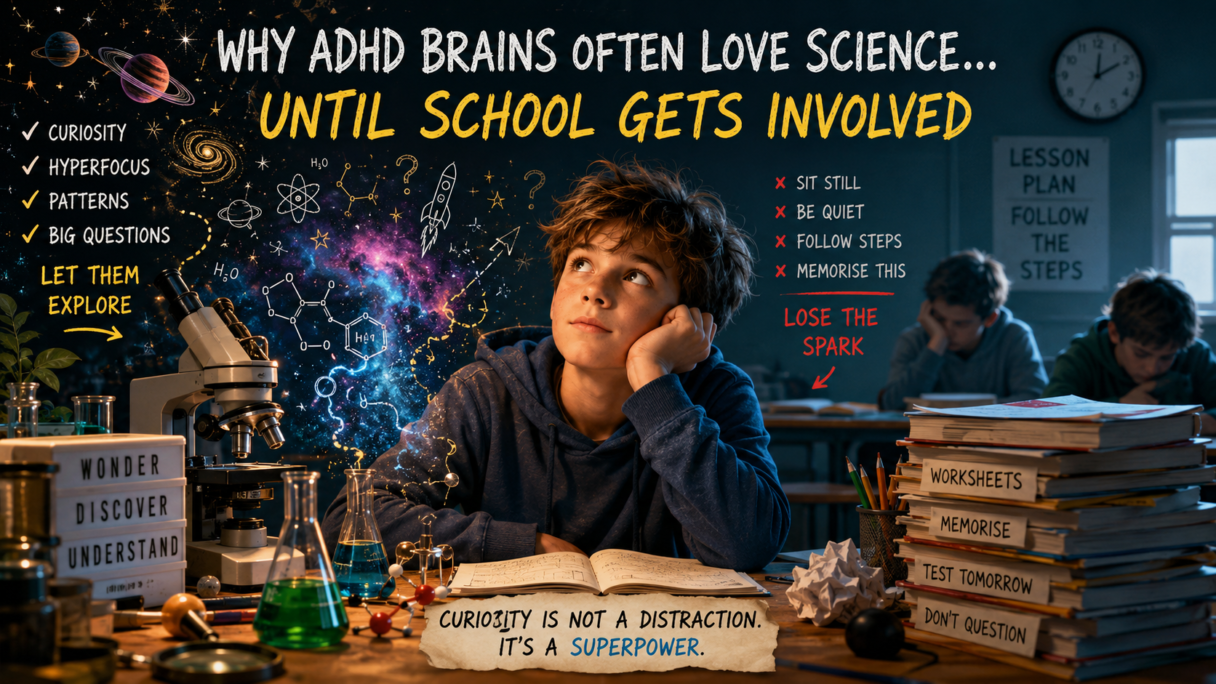
Why ADHD Brains Often Love Science…Until School Gets Involved
Walk into a room full of children and ask who likes science and you will usually get an enthusiastic reaction. Rockets. Volcanoes. Space. Dinosaurs. Fire. Magnets. Explosions disguised as “experiments”. Human beings arrive in the world naturally curious. A child can spend forty-five uninterrupted minutes asking why bubbles exist and whether fish sleep. Nobody teaches them to do that.
Then, somewhere along the line, many students begin quietly deciding they are “bad at science”.
Not because science itself changed.
Because the delivery system did.
For a lot of ADHD learners in particular, this shift can feel almost surreal. The same child who can spend six straight hours learning every known fact about black holes, sharks, Roman warfare, fungi, or particle accelerators suddenly cannot survive twenty minutes copying definitions from a whiteboard without mentally drifting into another dimension entirely.
Traditional education often interprets this as laziness, lack of discipline, poor focus, or disinterest.
But that interpretation may completely misunderstand what attention actually is.
Attention is not simply the ability to stare obediently at something for long periods of time. Human attention is heavily tied to meaning, novelty, emotional relevance, movement, urgency, curiosity, and reward. ADHD brains in particular tend to respond very strongly to these things. This is why an ADHD learner may forget where they put their shoes while simultaneously remembering every species featured in a documentary they watched three years ago at midnight.
The brain is not broken.
The brain is selective.
And science, at its best, is one of the most naturally rewarding subjects for that kind of mind.
The trouble begins when science stops feeling like discovery and starts feeling like administration.
Somewhere between “Why do stars exist?” and “Copy this diagram exactly as shown”, the spark can disappear.
Modern education still carries traces of its industrial roots. Rows. Timetables. Standardisation. Uniform pacing. Quiet compliance. The system values predictability because predictability is easier to measure. Unfortunately, curiosity is not always predictable. Curiosity wanders off-road. It interrupts. It asks inconvenient questions five minutes before the bell.
ADHD learners often do exactly the same thing.
This is partly why so many students labelled as “distracted” can become intensely focused when genuinely interested. Hyperfocus is one of the strangest and most misunderstood parts of ADHD. The popular stereotype paints ADHD as an inability to concentrate, but many people with ADHD can concentrate so deeply on stimulating tasks that time itself seems to vanish.
An ADHD learner might struggle to revise a worksheet for fifteen minutes and then accidentally spend four hours researching whether octopuses could theoretically survive on another planet.
From the outside this looks inconsistent.
Neurologically, it makes more sense than people realise.
The ADHD brain is heavily influenced by dopamine, a neurotransmitter involved in motivation, reward, anticipation, and interest. Tasks that feel repetitive, emotionally flat, or disconnected from meaning often fail to generate enough stimulation to sustain attention. Meanwhile, novelty and fascination can trigger enormous engagement.
In ordinary language…
The brain leans toward what feels alive.
This is why many ADHD learners thrive during practical science lessons. The moment learning becomes tactile, visual, experimental, or emotionally engaging, attention often improves dramatically. Chemical reactions. Building circuits. Watching cells under microscopes. Demonstrations involving pressure, motion, combustion, or light. Suddenly the brain has something to attach itself to.
The information gains texture.
A surprising number of students are not bad at learning at all. They are bad at learning in ways that drain all emotional energy from the subject.
There is a huge difference between memorising the definition of combustion and nearly setting your eyebrows on fire during a teacher demonstration involving magnesium ribbon.
One of those experiences tends to remain in the memory for longer.
The strange thing is that neuroscience already supports much of this. Emotionally meaningful learning tends to strengthen memory formation. Novel experiences are easier for the brain to retain. Active engagement improves understanding. Movement can support cognition. Curiosity improves recall.
Yet education systems often continue operating as though information retention is purely a matter of discipline.
Sit still.
Be quiet.
Concentrate harder.
As if the human brain were a malfunctioning office printer.
The irony is that many scientific breakthroughs throughout history came from minds that probably would not have thrived inside highly rigid educational systems themselves. Science has always depended on obsessive curiosity, unconventional thinking, fixation, experimentation, and people who become irrationally fascinated by questions others ignore.
The line between “gifted”, “eccentric”, and “difficult in school” has always been thinner than society likes to admit.
That does not mean every ADHD learner is secretly a misunderstood genius, despite what social media occasionally suggests between thirty-second productivity hacks and videos explaining neuroscience with dancing captions.
But it does mean the conversation deserves more nuance than simply framing attention as moral success or failure.
A learner who struggles with worksheets may still possess enormous intellectual curiosity.
A student who fidgets may still be deeply engaged.
A child staring out of the window may not be disengaged from thinking. Sometimes they are overloaded. Sometimes they are processing. Sometimes they are imagining connections the lesson has not reached yet.
Traditional classrooms are often designed around visible compliance rather than invisible cognition.
Those are not always the same thing.
This is partly why alternative educational environments can work so well for some neurodivergent learners. Places that allow autonomy, movement, conversational learning, practical experimentation, or self-directed exploration often unlock engagement that conventional systems failed to access.
Not because standards disappeared.
Because curiosity re-entered the room.
The modern world quietly reinforces this too. Many students now learn science through YouTube videos, simulations, documentaries, gaming, interactive models, and creators who understand pacing and engagement better than some textbooks ever did. A passionate science communicator online can sometimes achieve more in ten minutes than an hour of forced note-taking because they understand something simple:
Attention follows interest.
And interest is not a trivial thing. It is cognitive fuel.
The educational challenge moving forward is not merely “How do we make ADHD students behave more like traditional learners?”
It may be:
“How do we create learning environments that better reflect how human attention actually works?”
Because the issue is no longer isolated to ADHD learners alone.
Modern classrooms everywhere are colliding with a generation raised in highly stimulating informational environments. Attention itself has become fragmented, commercialised, competed over constantly. The old educational model increasingly feels like trying to run modern software on ageing hardware.
And yet beneath all the noise, something hopeful remains.
Curiosity is remarkably stubborn.
Even students who claim to hate science often still love questions. They still pause at strange facts. They still wonder about space, consciousness, disasters, evolution, weather, disease, the ocean, artificial intelligence, or whether humanity is making brilliant progress or accidentally speed-running its own collapse.
The instinct to understand the world never fully disappears.
Sometimes it just gets buried underneath assessment objectives and revision timetables.
Perhaps the real task for science education is not to force curiosity into existence.
Perhaps it is simply to stop crushing it so efficiently.
Because many ADHD learners do not need help becoming interested in science.
They need environments where their interest is allowed to breathe.
Book a Free Introductory Session
A relaxed, no-pressure session to see if this approach works for your child.
Leave a Reply