
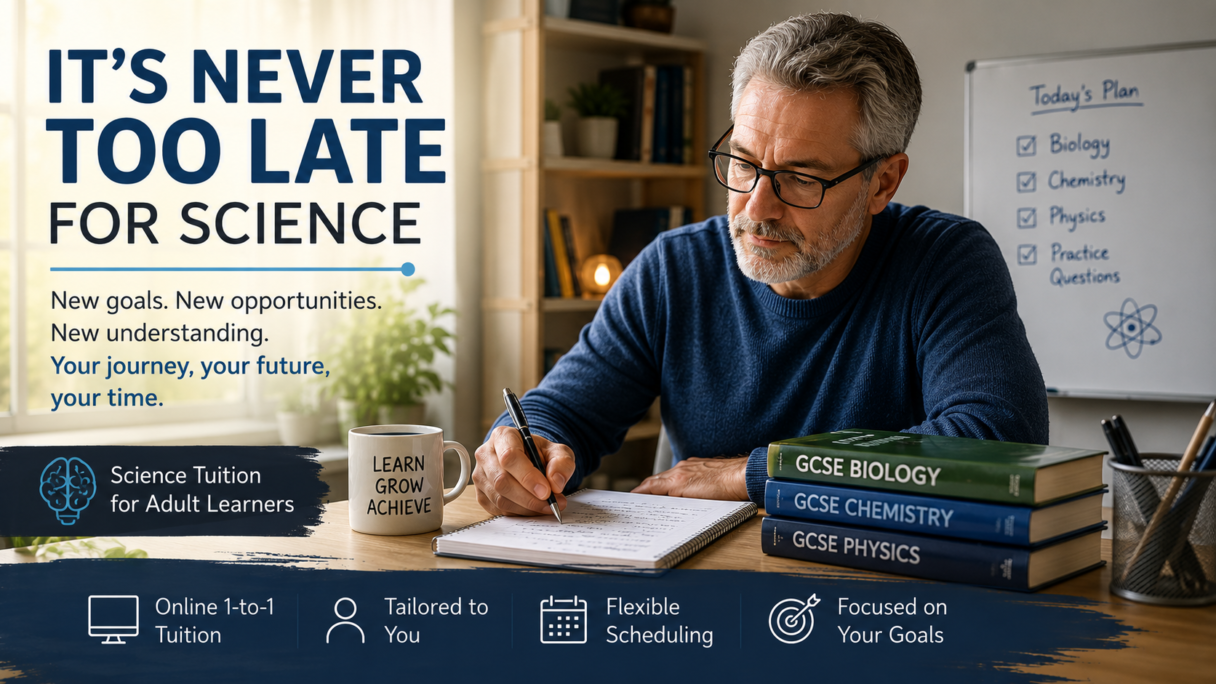
Returning to Science as an Adult…
Why It’s Never Too Late to Learn
Being honest, society seems to make the assumption that education belongs to the young.
We grow up believing that classrooms are places we pass through on the way to adulthood, that examinations are hurdles to clear before beginning our “real” lives, and that learning follows a fairly predictable path. School leads to college, college leads to work, and by the time we reach our twenties, our formal education is largely behind us.
Real life, however, has a habit of ignoring neat timelines.
People change careers. Families grow. Opportunities arise unexpectedly. Interests develop that simply were not there twenty years earlier. Sometimes a long-held ambition resurfaces after years of being pushed aside by work, finances or family commitments. At other times, circumstances change completely and new qualifications become the key to a different future.
For many adults, those new opportunities lead back to an unexpected place… science.
Whether it is studying for GCSE Science, preparing for an Access to Higher Education course, pursuing a nursing or healthcare career, meeting university entry requirements or simply satisfying a lifelong curiosity, increasing numbers of adults are choosing to return to education. Yet despite this growing demand, many discover that finding science tuition specifically designed for adult learners is surprisingly difficult.
That is unfortunate, because adult learners bring something unique to education. They arrive with life experience, determination and purpose. They are rarely studying because somebody else expects them to. They are studying because they have chosen to invest in themselves.
That choice deserves to be recognised and supported.
The Science You Left Behind Is Not the Science You Can Learn Today
One of the biggest misconceptions about returning to education is the belief that your experiences at school define your ability forever.
It is remarkably common to hear adults describe themselves as “not scientific” or say that they were “never any good at science”. Often those conclusions are based on events that happened decades ago. A difficult teacher, an examination that went badly, lessons that moved too quickly, or simply the feeling of sitting in a classroom where everyone else appeared to understand while you quietly fell behind.
Those experiences leave an impression.
Over time they become more than memories. They become stories we tell ourselves about who we are.
Yet there is an important distinction between struggling to learn something under one set of circumstances and being incapable of learning it altogether.
The teenager who found Chemistry confusing at sixteen is not the same person returning to education at forty-five. Years of work, life experience, problem solving and personal growth change the way we think, process information and approach challenges. Adults often possess patience, resilience and motivation that younger learners have not yet had the opportunity to develop.
Learning is not fixed.
Neither are people.
Why Adults Return to Science
Every adult learner has their own story, but many share similar motivations.
For some, the decision is practical. A new career in nursing, healthcare, laboratory work or education requires qualifications they never imagined needing. Others are preparing for university or Access to Higher Education courses and realise that science is the key to opening the next chapter of their lives.
Some are parents supporting their own children’s education. Helping with homework often rekindles an interest in subjects they once believed they had left behind. Others simply want to understand the world more deeply. They have discovered that curiosity has not diminished with age. If anything, it has become stronger.
Perhaps the most inspiring group are those who return simply because they want to prove something to themselves.
Not to anyone else.
To themselves.
They want to replace old assumptions with new understanding. They want to challenge the idea that one disappointing school experience should define an entire lifetime.
That takes courage.
Learning Without the Pressure
Adult learners often worry about returning to a classroom environment because they imagine it will feel exactly as it did at school.
Fortunately, it doesn’t have to.
One of the advantages of one-to-one online tuition is that learning can be shaped around the individual rather than forcing everyone into the same pace, structure or teaching style.
There is no pressure to keep up with thirty other students.
There is no embarrassment about asking questions.
There is no expectation that you should already remember topics you last encountered many years ago.
Instead, learning becomes a conversation.
Complex ideas are broken down into manageable steps. Questions are encouraged rather than discouraged. Time is spent building genuine understanding rather than simply preparing to reproduce information in an examination.
For many adult learners, this is a completely different educational experience from the one they remember.
Confidence Often Comes Before Progress
People sometimes assume that confidence is something that appears after success.
In education, the opposite is often true.
When learners feel safe enough to ask questions, admit uncertainty and make mistakes, genuine learning begins to take place. Without that confidence, even capable students may hesitate, second-guess themselves or avoid asking for clarification.
Over many years of teaching, I have become increasingly convinced that confidence is not an optional extra. It is one of the foundations upon which effective learning is built.
This philosophy was reinforced during more than a decade of teaching at Summerhill School, the internationally recognised democratic school founded by A.S. Neill.
Summerhill has long challenged conventional assumptions about education. While people often focus on its democratic structure, one of its most important lessons is perhaps much simpler. People learn best when they feel respected, trusted and free to develop at their own pace.
That principle applies just as much to adults as it does to children.
Perhaps even more so.
Adult learners frequently carry years of accumulated self-doubt. Creating an environment where that confidence can gradually be rebuilt is often every bit as important as teaching Biology, Chemistry or Physics.
Neurodiversity Does Not End at School
One of the most significant developments in recent years has been a greater understanding of neurodiversity in adulthood.
Many adults are only now discovering that ADHD, autism, dyslexia or other learning differences may have influenced their experiences throughout education. Some receive diagnoses later in life. Others simply begin recognising patterns that suddenly explain why traditional classrooms always felt exhausting or confusing.
For many, this realisation brings both relief and frustration.
Relief because experiences that once seemed like personal failings begin to make sense.
Frustration because appropriate support may never have been available when they were younger.
The encouraging news is that adults have choices.
Learning no longer has to happen within a rigid classroom system. Lessons can be adapted to suit the individual, making use of visual resources, structured explanations, technology and flexible pacing that reduce unnecessary stress while improving understanding.
Supporting autistic and ADHD learners has become an important part of my teaching, not because every learner requires identical methods, but because every learner deserves an approach that recognises how they learn best.
Education should adapt to people.
Not the other way around.
Science Is About Curiosity
One of the unfortunate consequences of school is that science can sometimes become associated almost exclusively with examinations.
Revision timetables.
Formula sheets.
Practical assessments.
Mark schemes.
Yet these are not science.
They are methods of assessment.
Science itself is something far more interesting.
Science is curiosity organised into questions.
Why does the sky appear blue?
How do vaccines work?
Why do batteries eventually run flat?
What happens inside our bodies when we exercise?
Why are some materials magnetic while others are not?
Children ask these questions naturally.
Adults ask them too.
Somewhere along the way, many people simply begin to believe that they are no longer qualified to explore the answers.
Nothing could be further from the truth.
Science belongs to anyone willing to remain curious.
Returning to Education Takes Courage
There is something quietly admirable about adults who decide to begin learning again.
Life is already busy.
There are careers, families, responsibilities and financial pressures competing for attention every day. Finding time to study requires commitment that should never be underestimated.
Adult learners are rarely chasing grades for their own sake.
More often they are pursuing opportunities.
A promotion.
A new profession.
University.
A personal ambition that has waited patiently for years.
Every lesson represents an investment in a future they have consciously chosen to build.
That determination deserves encouragement rather than judgement.
Why Personalised Tuition Makes a Difference
Every learner arrives with different strengths, different experiences and different goals.
Some need intensive preparation for GCSE examinations.
Others require support with specific topics before beginning an Access course.
Some have not opened a science book for twenty years and simply want to rebuild confidence from the foundations upwards.
Trying to teach all of these learners in exactly the same way would make very little sense.
Personalised tuition allows lessons to develop around the individual rather than around a predetermined programme. More time can be spent where it is needed. Familiar topics can be moved through more quickly. Learning becomes flexible, responsive and entirely focused on achieving the learner’s own objectives.
This is one of the greatest advantages of one-to-one tuition.
The lesson belongs to you.
It Is Never Too Late
Perhaps the greatest misconception about education is that it has an expiry date.
It doesn’t.
Curiosity certainly doesn’t.
The desire to understand, to improve, to explore new possibilities and to challenge ourselves is something that remains throughout life. Sometimes it lies dormant for years before circumstances bring it back into focus. Sometimes it never disappears at all.
Returning to science is not about rewriting the past.
It is about recognising that the future remains open.
The examination you struggled with years ago does not define what you can achieve today. The classroom where you lacked confidence does not determine how you learn now. Those experiences may explain part of your journey, but they do not have to decide where that journey ends.
Education is not reserved for childhood.
Learning is not limited by age.
Science does not belong only to schools, universities or laboratories.
It belongs to anyone prepared to ask questions, remain curious and discover that they are capable of far more than they once believed.
Science Tuition for Adult Learners
If you are considering returning to education, whether to gain GCSE Science qualifications, prepare for an Access to Higher Education course, pursue a career in nursing or healthcare, or simply build confidence in Biology, Chemistry or Physics, I offer personalised online science tuition designed specifically to support adult learners.
Drawing on more than a decade of teaching experience at Summerhill School, alongside extensive work supporting autistic, ADHD and home-educated learners, my approach focuses on creating calm, supportive learning environments where confidence can grow alongside knowledge.
Every learner’s journey is different, and every lesson is adapted to suit your goals, experience and preferred learning style.
If you’ve been wondering whether it’s too late to return to science, perhaps the better question is this:
What might become possible if you did?
Learn More
If you would like to find out more about dedicated online science tuition for adults, please visit the Science Tuition for Adult Learners page, where you’ll find further information about lessons, teaching approach and how to arrange a free introductory session.
Book a Free Introductory Session
A relaxed, no-pressure session to see if this approach works for your child.
Leave a Reply