
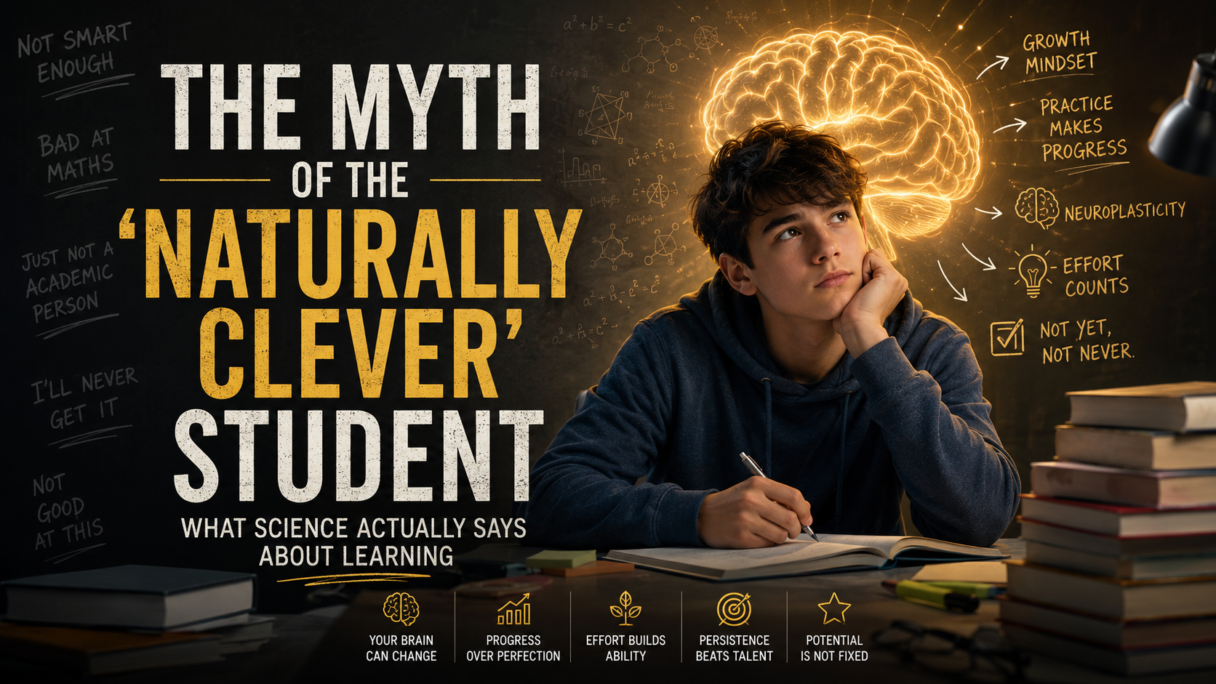
The Myth of the “Naturally Clever” Student
What science actually says about learning
Every school seems to have them.
The student who never appears to revise but somehow walks into exams with the relaxed confidence of a person returning a library book. The one teachers quietly use as an example. The one other students stare at with a strange mixture of admiration and resentment.
“They’re just naturally clever.”
It is one of the most common labels in education…and one of the most damaging.
Not because intelligence does not exist. Of course it does. People are different. Brains are different. Some people process language quickly. Some recognise patterns rapidly. Some retain information with unusual ease.
But the idea that learning belongs primarily to “naturally clever” people has quietly distorted the way millions of students see themselves.
Especially the ones who struggle early.
Especially the ones whose confidence takes a hit before they have even properly started.
And perhaps most painfully of all…especially the students who are actually capable, but do not perform capability in the way schools expect.
Because schools often reward visible fluency, not invisible effort.
The student who answers quickly looks intelligent.
The student who pauses looks uncertain.
The student who finishes first appears capable.
The student staring at the page appears weaker.
Yet neuroscience keeps uncovering something awkward for the mythology of effortless brilliance:
Learning is far less fixed than people like to imagine.
Brains are not static containers with labels stamped on them at birth. They are adaptive systems. Messy systems. Systems that strengthen, weaken, reorganise, and reshape themselves constantly through experience, repetition, stress, emotion, sleep, environment, and attention.
In other words…the story is more complicated than “smart people succeed and everybody else tries to keep up.”
And honestly, that is probably a relief.
The strange social hierarchy of classrooms
Children learn very quickly where they stand socially inside education.
Not officially, of course. Schools rarely announce rankings aloud. Nobody gathers students together on Monday morning to declare:
“Right then. Oliver is one of the clever ones. Ethan is average. Chloe struggles with maths. Amelia is probably doomed by Year 9.”
But labels form anyway.
Quietly.
Repeated test scores.
Teacher expectations.
Who gets praised.
Who gets extra help.
Who gets interrupted less.
Who gets called “gifted”.
Who gets described as “not applying themselves”.
Over time, many students begin building an identity around these signals.
And identities are powerful things.
A child who believes they are intelligent often becomes more willing to attempt difficult things because failure does not threaten their core identity. A child who believes they are “bad at school” may begin avoiding challenge entirely because every mistake feels like confirmation.
The science behind this is well established. Psychologists have repeatedly found that beliefs about intelligence influence motivation, resilience, and academic persistence. Students who see ability as developable are generally more likely to persevere through difficulty than students who see intelligence as fixed.
Which creates a strange paradox.
Sometimes the student praised for being “naturally smart” becomes fragile around failure.
And sometimes the student who struggled early develops stronger long-term learning habits because they had to.
Real life quietly supports this all the time.
Adults know people who were “brilliant at school” yet later drifted.
They also know people who barely survived formal education but eventually flourished once confidence, environment, or purpose changed.
Human beings are not exam results frozen in time.
The brain is not a photograph
One of the biggest misconceptions about intelligence is the idea that the brain is fixed…like a photograph developed once and then sealed forever.
Modern neuroscience paints a very different picture.
The brain changes physically through learning. Neural pathways strengthen through repeated use. Connections become more efficient. Skills that once required enormous effort can eventually become automatic through practice and reinforcement.
This process is called neuroplasticity.
f(x)=\text{learning growth over time}
The term sounds technical and slightly robotic, but the underlying idea is deeply human:
Your brain adapts to what you repeatedly do.
Taxi drivers navigating large cities show measurable structural brain changes associated with spatial memory. Musicians develop strengthened neural pathways linked to fine motor control and auditory processing. Language learners physically reshape aspects of brain connectivity over time.
None of this means “everybody can become Einstein through positive thinking”.
But it does dismantle the fatalistic idea that struggling at something automatically reveals permanent inability.
Often it simply reveals unfamiliarity.
Or lack of repetition.
Or anxiety.
Or exhaustion.
Or a teaching style mismatch.
Or a nervous system under stress.
A teenager sitting silently in a maths classroom may not be experiencing “low intelligence” at all. They may be experiencing cognitive overload, low confidence, poor sleep, emotional distraction, fear of embarrassment, sensory overwhelm, executive dysfunction, or ten other invisible factors that never appear on report cards.
Education systems are not always brilliant at distinguishing between “cannot” and “currently cannot”.
That distinction matters more than people realise.
Why quick answers fool us
Humans are surprisingly bad at recognising learning in real time.
We mistake speed for understanding constantly.
Fast recall looks intelligent because it is socially impressive. Someone answering immediately gives the appearance of mastery. But deeper learning is often slower, quieter, and less visually dramatic.
Some students process internally before speaking.
Some need extra retrieval time.
Some think conceptually but struggle with verbal expression.
Some understand deeply yet perform inconsistently under pressure.
And some students simply learn differently.
ADHD learners, for example, may absorb enormous amounts of information through interest-based engagement while struggling with rigid task structures. Autistic learners may excel in deep pattern recognition while finding classroom social dynamics exhausting. Dyslexic students may develop sophisticated verbal reasoning while struggling with conventional written output.
Yet traditional education environments often reward one particular style of cognition:
- quick
- organised
- verbally confident
- compliant
- consistent
If you naturally fit that mould, school can feel validating.
If you do not, school can quietly convince you that intelligence belongs to other people.
That emotional narrative can linger for decades.
You meet adults everywhere carrying old educational identities like inherited weather systems.
“I was never academic.”
“I’m just not clever.”
“I was rubbish at science.”
“I can’t do maths.”
Often these statements are less factual than historical.
They describe an experience…not a fixed truth.
Effort became uncool somehow
One of the oddest cultural habits in education is how heavily we romanticise effortless success.
People admire the student who succeeds without trying far more than the student who works relentlessly.
The second student is often respected…but the first becomes mythologised.
Perhaps because effortless talent feels magical. It reassures people that greatness is innate and therefore somehow purer.
But hidden beneath most high achievement sits repetition so dull and unglamorous that social media would never tolerate it for more than six seconds.
Practice.
Mistakes.
Review.
Confusion.
Sleep.
Retrying.
More mistakes.
Learning is frequently repetitive because biology itself is repetitive.
Neural strengthening depends on reinforcement.
Memory retrieval strengthens retention.
Spacing study sessions improves recall.
Testing yourself works better than endlessly rereading notes because retrieval forces the brain to rebuild access pathways rather than merely recognising familiar words.
Unfortunately, none of this feels cinematic.
There is no dramatic soundtrack behind somebody making flashcards on a Tuesday evening while wondering whether any of it is sinking in.
Yet this quiet process is often what actual learning looks like.
Not genius descending from the heavens.
Just gradual adaptation.
The danger of early labels
Children remember labels far longer than adults think.
A single careless comment from a teacher can echo internally for years:
“You’re not really a maths person.”
The problem is not merely emotional.
Labels shape behaviour.
A student who believes ability is fixed may avoid challenge because struggle feels humiliating rather than normal. Meanwhile, students praised only for intelligence sometimes become terrified of difficult tasks because failure threatens their identity as “the smart one”.
Ironically, this can create avoidance in both directions.
The “weak” student stops trying because they expect failure.
The “gifted” student avoids difficulty because they fear discovering limits.
Meanwhile the healthiest learners are often the ones who quietly accept that confusion is part of the process.
Which sounds obvious as an adult.
But schools rarely feel that way emotionally.
For many students, confusion feels public.
And public confusion can feel unbearable at thirteen years old.
Learning is biological…but also emotional
This is the part education discussions sometimes miss.
Learning is not purely intellectual.
Emotion affects cognition constantly.
Stress impacts memory formation. Chronic anxiety affects concentration. Sleep deprivation reduces cognitive performance dramatically. Shame interferes with participation. Fear narrows attention.
A student dealing with bullying, family instability, burnout, isolation, or emotional exhaustion may appear disengaged academically when in reality their nervous system is simply prioritising survival elsewhere.
Even boredom itself is more complex than laziness.
The brain seeks stimulation, novelty, meaning, and emotional relevance. When learning feels disconnected from lived experience, attention naturally drifts.
Adults do exactly the same thing every day.
People can spend three hours researching obscure Roman road systems online because curiosity activates engagement…yet struggle to read a mandatory workplace PDF for six minutes without opening another browser tab.
That is not moral failure.
That is humanity.
Perhaps intelligence is less theatrical than we imagined
The older you get, the stranger the mythology of “naturally clever people” begins to feel.
Because real intelligence in adulthood often looks nothing like school mythology predicted.
Sometimes it looks like adaptability.
Sometimes emotional regulation.
Sometimes curiosity.
Sometimes persistence.
Sometimes humility.
Sometimes the willingness to keep learning after embarrassment.
And sometimes it simply looks like somebody who did not give up on themselves too early.
Education matters enormously. Knowledge matters enormously. Science matters enormously.
But human beings are rarely captured fully by a ranking system built around timed performance under artificial conditions.
Some students bloom late.
Some recover confidence slowly.
Some only discover their learning style in adulthood.
Some never believed they were intelligent until the right teacher, mentor, book, or environment changed the story slightly.
That possibility matters.
Because somewhere, quietly reading articles like this, are students who already believe the race is over before they have even properly begun.
And perhaps the most useful thing science can offer them is not empty motivational slogans…but a calmer, more grounded truth:
Brains change.
People adapt.
Learning is rarely linear.
And struggling does not automatically mean incapable.
Book a Free Introductory Session
A relaxed, no-pressure session to see if this approach works for your child.
Leave a Reply