
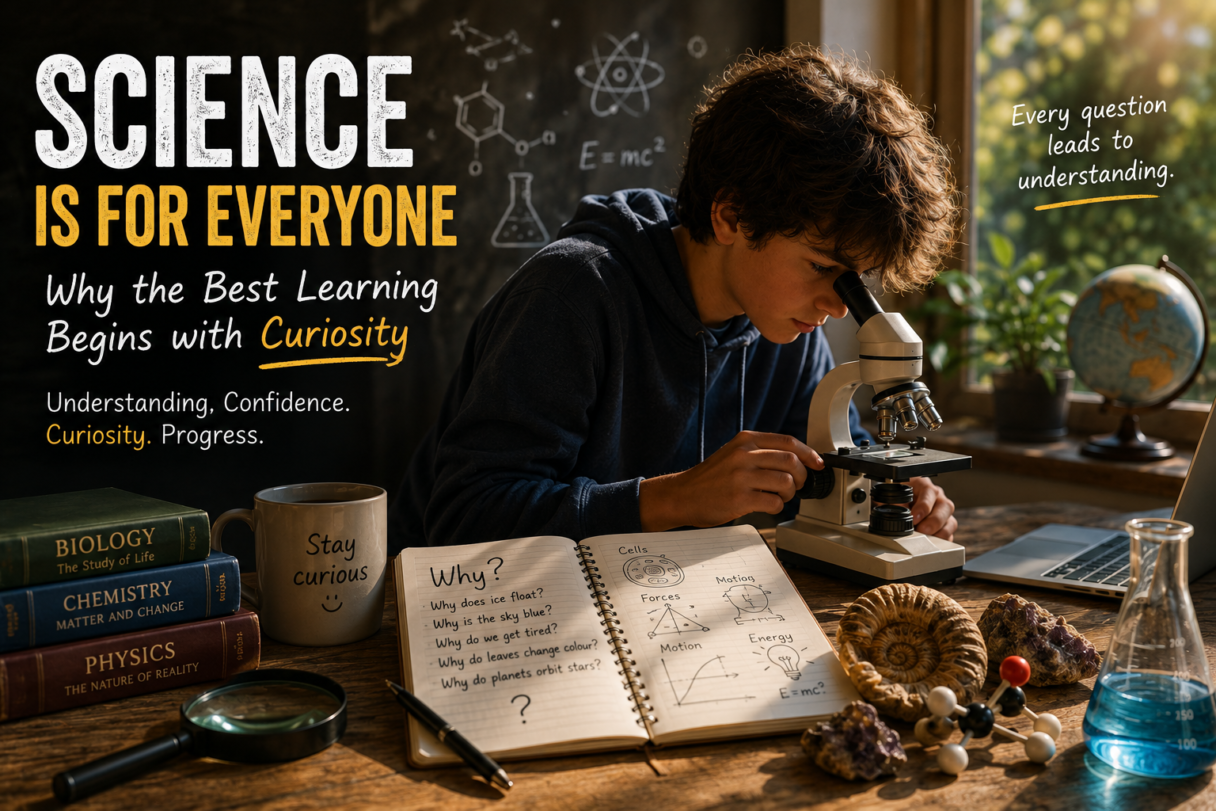
Science Is for Everyone… Why the Best Learning Begins with Curiosity
If you ask most adults about their memories of school science, the answers are often surprisingly similar.
Some remember enjoying practical experiments but struggling with the written work. Others recall memorising endless facts for examinations, only to forget them a few weeks later. Quite a few quietly admit that somewhere along the way they decided they simply “weren’t good at science.”
It is a conclusion many people carry with them for years.
Yet, in my experience as a science tutor, it is also one of the most inaccurate.
Science has never been about belonging to an exclusive group of naturally gifted people. It has never required a particular personality, a certain way of thinking or a specific background.
At its heart, science begins with something much simpler.
Curiosity.
Every scientific discovery in history started with somebody asking a question.
Why does this happen?
How does that work?
What would happen if…?
Children ask questions like these every day. They are naturally curious about the world around them. They explore, experiment, test ideas and occasionally make spectacular messes along the way. That curiosity is one of the greatest learning tools we possess.
Unfortunately, somewhere between childhood and adulthood, many people begin replacing questions with self-doubt.
Instead of asking why something happens, they begin asking whether they’re clever enough to understand it.
The answer is almost always yes.
Science Is About Understanding… Not Memorising
One of the biggest misconceptions surrounding science education is that success depends on remembering enormous amounts of information.
Of course, there are facts to learn. Biology, Chemistry and Physics each have their own terminology, concepts and processes. Examinations require knowledge and preparation.
But genuine understanding runs far deeper than memorisation.
When you understand why a chemical reaction takes place, remembering it becomes much easier.
When you understand how forces act on an object, the equations suddenly make sense.
When you understand how cells work together, Biology becomes a fascinating story rather than a list of unfamiliar words.
The best learning happens when knowledge connects together.
That is why my approach to science tuition always begins with understanding first.
Once understanding develops, confidence usually follows.
Every Learner Is Different
After many years teaching young people and adults, one truth has become impossible to ignore.
There is no such thing as a “normal” learner.
Some people absorb information visually.
Others prefer discussion.
Some need time to process new ideas before responding.
Others learn by experimenting and asking questions as they go.
Many students who have ADHD or are autistic discover that they understand science extremely well once lessons are adapted to suit how they naturally learn.
The same is true for many home-educated students, adult learners returning to education after years away, or young people who simply find large classrooms overwhelming.
Good teaching is not about expecting everyone to learn in exactly the same way.
It is about discovering the approach that allows each individual learner to succeed.
That is one of the greatest advantages of personalised one-to-one tuition.
Lessons move at your pace.
Questions are encouraged rather than rushed.
Topics can be revisited without embarrassment.
Understanding matters far more than simply moving on to the next chapter.
Confidence Changes Everything
Many students don’t actually have a science problem.
They have a confidence problem.
Perhaps they struggled with one topic several years ago and gradually convinced themselves they were “bad at science.”
Perhaps they compared themselves with classmates who seemed to grasp everything immediately.
Perhaps they simply never had the opportunity to ask the questions they really wanted to ask.
Confidence affects every aspect of learning.
When learners worry about getting the wrong answer, they often stop answering altogether.
When they stop answering, they stop asking questions.
Eventually, curiosity begins to disappear.
One of the most rewarding parts of tutoring is watching that confidence slowly return.
Students begin asking more questions.
They attempt problems they would previously have avoided.
Mistakes become part of learning rather than something to fear.
Over time, science becomes enjoyable again.
That transformation is often far more important than any examination result.
Science Is Part of Everyday Life
Science is sometimes presented as though it only exists inside laboratories or textbooks.
In reality, it surrounds us constantly.
Why does bread rise?
Why does ice float?
Why do rainbows appear?
How do medicines work?
Why does your mobile phone connect to satellites and networks across the world?
Science helps us understand the ordinary moments we experience every single day.
Once learners begin making those connections, subjects that once seemed abstract suddenly become relevant.
Biology explains the living world around us.
Chemistry explains the materials we use every day.
Physics explains the forces and energy that shape almost everything we experience.
The more we understand, the more interesting the world becomes.
Learning Doesn’t End at Sixteen
Education is often presented as though it follows a fixed timetable.
School.
College.
University.
Career.
Life rarely follows such a straightforward path.
Many adults decide to return to education later in life.
Some are preparing for careers in healthcare or nursing.
Others need GCSE Science qualifications for university or professional development.
Some simply want to challenge assumptions they have held about themselves for years.
Age has never been a barrier to learning.
In fact, adult learners often bring determination, perspective and motivation that younger students are still developing.
Whether you are sixteen or sixty, curiosity remains one of your greatest strengths.
Science Tuition That Fits the Learner
Every learner arrives with different goals, experiences and ways of understanding the world.
That is why every lesson should begin with the learner, not the syllabus.
My online science tuition is designed around helping each individual build confidence, understanding and genuine enjoyment of Biology, Chemistry and Physics.
Whether you are preparing for GCSE examinations, supporting home education, returning to education as an adult, or looking for a tutor experienced in working with ADHD and autistic learners, lessons are tailored to your needs rather than following a one-size-fits-all approach.
Science should never feel intimidating.
It should feel interesting.
It should encourage questions.
It should build confidence.
Most of all, it should remind us that learning has never been about already knowing the answers.
It has always begun with being curious enough to ask the next question.
Looking for Personalised Online Science Tuition?
If you’re searching for an experienced online science tutor who believes understanding comes before memorisation, I’d be delighted to help.
Drawing on more than a decade of teaching experience, including time at the internationally renowned Summerhill School, I provide calm, personalised one-to-one science tuition for GCSE students, home-educated learners, adult students and neurodivergent learners, including those with ADHD and autism.
Whether your goal is to improve confidence, prepare for examinations, or simply rediscover a love of science, every lesson is designed around the way you learn best.
Because science isn’t just for the few.
It’s for anyone who has ever looked at the world and wondered, “Why?”
Book a Free Introductory Session
A relaxed, no-pressure session to see if this approach works for your child.
Leave a Reply