
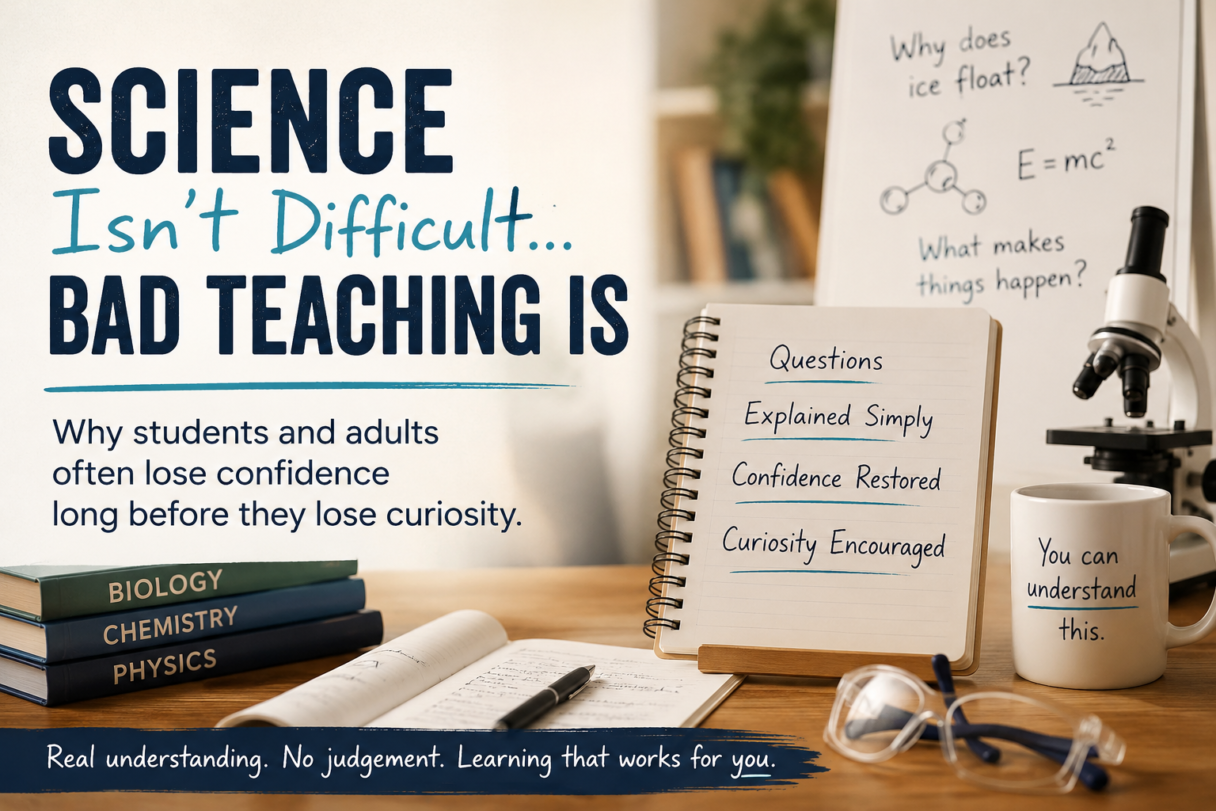
Science Isn’t Difficult…Bad Teaching Is
Why students and adults often lose confidence long before they lose curiosity.
Whether you’re a GCSE student, a parent looking for the right tutor, a home educator, or an adult returning to science after many years, this article is for you.
There is a phrase I’ve heard countless times over the years, spoken by teenagers preparing for GCSEs, adults returning to education after decades away from a classroom, and parents apologetically explaining why their son or daughter is struggling.
“I’m just not very good at science.”
Sometimes it’s said with a shrug, sometimes with frustration, and occasionally with genuine embarrassment. As though science belongs to a select group of naturally gifted people while everyone else simply has to accept they’re not wired that way.
The truth is, I don’t believe that for a second.
After years of teaching students of all ages and abilities, I’ve reached a rather different conclusion. Most people who believe they’re “bad at science” aren’t bad at science at all. They’ve simply spent years being taught in a way that never really worked for them.
That’s a very different problem. More importantly, it’s one that can often be solved.
Science belongs to everyone
Science isn’t an exclusive club reserved for future doctors, engineers or astronauts. It isn’t a collection of impossible equations designed to catch people out, nor is it a mountain of facts that only the brightest students can memorise.
At its heart, science is simply curiosity with a method.
Why does ice float?
Why does bread rise?
Why do we yawn?
Why is the sky blue?
Why do medicines work?
Children ask questions like these naturally. Nobody teaches a five-year-old to be curious. They arrive equipped with curiosity from the very beginning.
Somewhere along the journey through education, however, that curiosity can become buried beneath revision timetables, examination pressures and an uncomfortable fear of getting the wrong answer.
Instead of exploring the world, students begin trying to survive it.
That isn’t science’s fault.
Confidence disappears surprisingly quickly
One of the saddest moments in education is watching somebody decide they can’t do something long before they’ve genuinely had the opportunity to learn it.
Perhaps they struggled with one topic.
Perhaps they missed several weeks through illness.
Perhaps a teacher moved too quickly because thirty other pupils needed to keep pace.
Perhaps they became frightened of asking questions because everyone else appeared to understand.
Perhaps somebody laughed when they answered incorrectly.
Whatever the reason, a small crack appears in confidence.
That crack grows.
Before long, the student isn’t saying, “I don’t understand electricity.”
They’re saying, “I’m rubbish at science.”
Notice the difference.
One statement is about knowledge.
The other is about identity.
Unfortunately, identities are much harder to change than facts.
Adults carry invisible school bags
Adults returning to education often surprise me.
Not because they lack ability, but because they carry experiences from school that happened twenty or thirty years ago as though they occurred last Tuesday.
“I hated science.”
“My teacher made me feel stupid.”
“I never understood chemistry.”
“I was always bottom set.”
Those memories become remarkably heavy luggage.
Yet when we begin working together something interesting usually happens.
Without the pressure of a busy classroom, without worrying about looking foolish in front of classmates, and without someone racing through a syllabus, concepts begin making sense.
The person hasn’t suddenly become more intelligent overnight.
They’ve simply been given permission to learn differently.
Adults also possess something many teenagers underestimate.
Perspective.
They’re learning because they want to.
They ask brilliant questions because they aren’t afraid to admit what they don’t know.
They make connections between science and everyday life because they’ve actually lived it.
That’s an enormous advantage.
Teenagers deserve better too
It’s easy to assume that only adults lose confidence.
The reality is very different.
Every year, bright, thoughtful young people convince themselves they’re failures because they’ve scored poorly in a mock exam or because one particular topic refuses to click.
Imagine learning to drive.
Would anyone expect you to master every manoeuvre after a couple of lessons?
Of course not.
Yet we sometimes expect teenagers to understand atomic structure, genetics, chemical reactions and electricity after hearing each topic explained once or twice in a busy classroom.
When that doesn’t happen, they assume the fault lies with them.
It rarely does.
Learning isn’t a race.
It’s a process.
Every brain approaches learning differently
One of the greatest myths in education is the idea that every student should learn in exactly the same way.
Life doesn’t work like that.
Some people learn by seeing.
Others need to hear ideas explained aloud.
Some need diagrams.
Some need practical examples.
Others need time.
Plenty simply need somebody to explain the same concept using different words.
That isn’t weakness.
It’s humanity.
Over the years I’ve worked with students who have ADHD, autism, dyslexia, anxiety, low confidence and all manner of different learning preferences. I’ve also taught students with none of those labels who simply needed a calmer explanation than they’d previously received.
Good teaching isn’t about fitting students into one method.
It’s about finding the method that fits the student.
That philosophy has stayed with me throughout my career and remains at the heart of every lesson I teach today.
Science isn’t about memorising…it’s about understanding
If I had a pound for every student who thought success in science meant memorising endless facts, I’d probably be writing this from a beach somewhere.
Memorising has its place.
There are equations to remember.
Definitions matter.
Key terminology matters.
But memorising without understanding is like learning the words to a song in a language you don’t speak.
You may reproduce it perfectly.
That doesn’t mean it makes any sense.
Real learning happens when ideas connect.
When students understand why something happens, remembering the detail becomes infinitely easier.
Suddenly photosynthesis isn’t just another awkward word.
It’s the remarkable process that allows almost all life on Earth to exist.
Electricity isn’t mysterious.
It’s simply charges behaving in predictable ways.
Chemistry isn’t magic.
It’s patterns.
Science becomes less intimidating the moment it starts telling a story.
The question nobody should fear asking
One of my favourite questions is also one of the shortest.
“Why?”
Unfortunately, it’s often the question students become most reluctant to ask.
They’re worried they’ll sound silly.
They’re convinced everyone else already understands.
They’re afraid of holding the class back.
So they remain quiet.
Learning stops.
I’ve never believed there are stupid questions.
Only missed opportunities to explain something differently.
Sometimes a student needs an entirely new explanation.
Sometimes they simply need the confidence to ask for one.
That is perfectly okay.
In fact, it’s exactly how learning should work.
This is Part One of the cornerstone article. It establishes the central argument, builds trust with both parents and adult learners, and sets up the practical side of your teaching philosophy.
Good teaching begins with listening
When someone contacts me for the first time, whether it’s a parent looking for GCSE support or an adult thinking about returning to education, I don’t immediately start talking about exam boards, revision schedules or grades.
Instead, I want to know about the person.
What do they already understand?
Which topics make them anxious?
When did science start feeling difficult?
What are they hoping to achieve?
Those answers tell me far more than a mock exam result ever could.
Every student arrives with a different story. Some have simply fallen behind after missing lessons. Others have spent years believing they’re incapable because they’ve never experienced science being explained in a way that clicks. Some arrive feeling confident but want to push themselves further.
No two journeys are identical, so no two lessons should be either.
Understanding before remembering
One of the biggest mistakes in education is assuming that remembering automatically leads to understanding.
In reality, it usually works the other way around.
Once something genuinely makes sense, remembering it becomes much easier.
Think about learning to ride a bicycle. Nobody memorises a list of instructions and suddenly rides confidently down the road. You wobble, adjust, try again, ask questions, make mistakes and gradually your brain begins connecting everything together.
Science works remarkably well in exactly the same way.
Concepts build upon one another.
Understanding grows layer by layer.
Confidence follows naturally.
That’s why my lessons focus on building strong foundations rather than rushing through topics simply to tick boxes.
Learning without fear
Fear is one of the least discussed barriers to education.
Not fear of science itself.
Fear of looking foolish.
Fear of asking questions.
Fear of making mistakes.
Fear of disappointing parents.
Fear of failing exams.
When fear walks into a lesson, curiosity quietly walks out.
I’ve always believed the best learning happens in an environment where questions are welcomed, mistakes are expected and nobody feels judged for not understanding something immediately.
That isn’t lowering standards.
It’s removing unnecessary obstacles.
Every scientist who has ever made an important discovery has made mistakes along the way. Trial and error isn’t a weakness in science. It’s one of its greatest strengths.
Students deserve the same freedom.
Lessons that meet you where you are
One of the advantages of one-to-one online tuition is that everything happens at your pace.
If you understand a topic quickly, wonderful. We move on.
If you need another explanation, another example or another way of looking at the problem, that’s exactly what we’ll do.
There is no embarrassment.
No competition.
No feeling that you’re holding anyone else back.
Sometimes a student needs five minutes.
Sometimes they need fifty.
The important thing isn’t how long it takes.
The important thing is that, by the end, it makes sense.
I’ve often found that a concept which seemed impossible in a classroom suddenly becomes perfectly understandable when it’s explained calmly, step by step, with time to stop and ask, “Can we go over that again?”
The answer to that question will always be yes.
More than preparing for an exam
Of course, examinations matter.
GCSE results can open doors to further education, apprenticeships and future careers.
Adults returning to education often need qualifications to move into a new profession or simply to achieve a personal ambition they’ve carried for years.
We’ll absolutely work towards those goals.
But I also believe science has something much bigger to offer.
It teaches us how to think.
How to question.
How to test ideas.
How to separate evidence from assumption.
Those skills don’t disappear once the exam paper has been handed in. They stay with us for life, helping us make better decisions, understand the world around us and approach problems with confidence rather than fear.
That’s why I don’t simply teach students to pass exams.
I teach them to understand the subject.
The grades usually follow.
A different way of teaching
My time teaching at Summerhill reinforced something I’d already begun to suspect.
People learn best when they feel respected.
Not pressured.
Not compared.
Not treated like numbers on a spreadsheet.
Respected.
That philosophy continues to shape every lesson I teach today.
Whether I’m working with a Year 10 student who has lost confidence, a home-educated learner preparing for GCSEs or an adult returning to education after many years away, my aim is always the same.
To make science feel approachable.
To make questions feel welcome.
To help curiosity find its way back.
For parents
Watching your child struggle can be incredibly difficult.
You know they’re capable.
You can see they’re trying.
Yet homework becomes a battleground, revision turns into frustration and confidence slowly begins to disappear.
Sometimes what a student needs isn’t more hours of study.
Sometimes they simply need a different voice.
A different explanation.
A little patience.
An opportunity to ask questions they don’t feel comfortable asking in school.
I’ve seen confidence return surprisingly quickly once students realise they aren’t expected to know everything immediately.
That’s often the moment genuine progress begins.
For adults
If you’ve been thinking about returning to education, let me reassure you of something.
You are not too old.
You haven’t left it too late.
You haven’t “missed your chance.”
Some of the most rewarding lessons I’ve ever taught have been with adults who believed education had passed them by.
Life experience brings advantages that classrooms rarely acknowledge. Adults ask thoughtful questions, recognise patterns more easily than they expect and usually have a clear reason for learning.
That motivation is incredibly powerful.
Whether you’re working towards a GCSE, preparing for further study or simply proving something to yourself, you’ll find a supportive environment where your questions are valued and your progress matters.
Science was never the problem
Over the years I’ve become increasingly convinced that science itself isn’t what puts people off.
Poor experiences do.
Being rushed.
Being overlooked.
Feeling embarrassed.
Being told to memorise instead of understand.
Being left behind while everyone else appears to move on.
None of those things are science.
They’re simply barriers that can be removed.
Once they are, something rather wonderful often happens.
People rediscover the curiosity they had as children.
They begin asking questions again.
They start noticing patterns in the world around them.
And somewhere along the way, they quietly stop saying, “I’m just not good at science.”
A final thought
If there’s one thing I’d like every student and every adult learner to take away from this article, it’s this.
Your ability is not defined by one exam, one teacher or one difficult year at school.
Learning isn’t about keeping pace with everyone else.
It’s about understanding.
It’s about confidence.
It’s about discovering that the things which once seemed impossible often become surprisingly straightforward when someone takes the time to explain them in a way that works for you.
Science has never belonged to a select few.
It belongs to anyone who’s curious enough to ask questions and determined enough to keep looking for the answers.
If you’re searching for a tutor who will meet you where you are, explain things clearly, work at your pace and help you rebuild confidence as well as knowledge, I’d be delighted to help.
After all…
Science isn’t difficult.
Sometimes it just needs to be taught differently.
Book a Free Introductory Session
A relaxed, no-pressure session to see if this approach works for your child.
Leave a Reply