
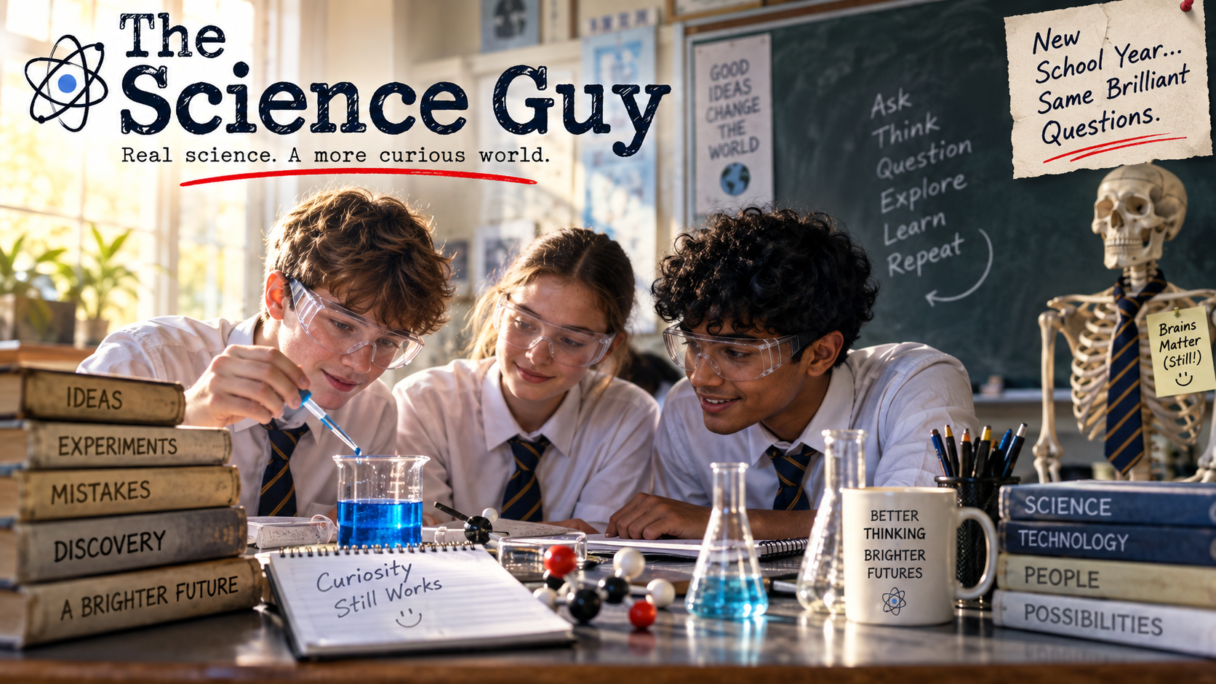
The New School Year… and Why Your Brain Hates Shortcuts
A back-to-school essay on learning, memory, and the uncomfortable truth about AI
September always feels different.
Even if you are long past school age, there is something about this time of year that suggests fresh notebooks, sharpened pencils, slightly too-tight uniforms and the optimistic belief that this will be the year everything stays organised. It rarely does, of course. By October someone has misplaced a PE kit, a calculator has mysteriously vanished into another dimension, and parents are once again asking the timeless question: “How have you lost it already?”
Yet beneath those familiar rituals sits something far more important than timetables and stationery. September is one of the few moments in modern life when millions of people collectively decide to become learners again. Children return to classrooms, teachers begin the careful work of building another year’s worth of understanding, and adults quietly remember subjects they were convinced they’d never need… usually while helping with homework.
This year, however, the new term arrives with an extra layer of uncertainty. Artificial intelligence has wandered into education with remarkable speed, and suddenly every school, college and university is asking the same question. If a machine can explain almost anything instantly, what is the purpose of learning it ourselves?
It is an attractive question.
It is also, I think, the wrong one.
The difference between knowing and looking up
Human beings have always invented tools that make life easier. We built wheels because walking everywhere was exhausting, washing machines because scrubbing clothes by hand was miserable, and calculators because nobody genuinely enjoys long division on a Friday afternoon.
Every technological leap has prompted the same anxiety: Will people stop thinking?
Sometimes the fear proves exaggerated. Calculators did not destroy mathematics, and word processors did not eliminate writing. What they did do was shift our attention away from repetitive mechanics and towards higher-order thinking.
AI feels different only because it appears to operate much closer to the thing we value most… thought itself.
A student can now ask an AI to explain photosynthesis, summarise Shakespeare, solve simultaneous equations or produce a revision timetable before the kettle has finished boiling. The responses are often impressive. Occasionally they are brilliant. Sometimes they are confidently wrong, which is perhaps the most human characteristic of all.
The temptation is to believe that access to information is equivalent to education. It has never been true. A library has always contained more knowledge than any individual reader, yet nobody has ever claimed that simply standing in the library makes you educated. Knowledge still has to be organised, questioned, connected and understood inside your own head.
That process is considerably slower than asking a chatbot.
It is also the entire point.
Why struggling is surprisingly good for you
One of the least popular findings in educational psychology is that learning often improves when it feels slightly difficult.
Students understandably dislike hearing this. Nobody enjoys spending twenty minutes staring at a chemistry calculation that refuses to make sense. The immediate assumption is that difficulty means failure, yet the brain tells a rather different story.
Every time we wrestle with a problem, something remarkable happens beneath the surface. We retrieve older knowledge, test possible solutions, recognise mistakes and gradually strengthen the pathways that connect ideas together. Memory is not built by reading the correct answer repeatedly; it is built by repeatedly attempting to retrieve it.
Think about learning to ride a bicycle. Watching someone else balance perfectly is informative, but it contributes very little to your own ability. The learning happens during the wobbling, the overcorrecting, the near-collisions with hedges and the eventual moment when balance stops being something you consciously perform. Your brain has quietly rewired itself through experience.
Science works in much the same way.
A student who eventually discovers why the equation works will almost always remember it better than the student who merely copied the solution. The frustration was not an obstacle to learning. It was part of the mechanism.
The classroom has become a fascinating experiment
UNESCO’s Digital Learning Week begins this week in Paris under the wonderfully honest theme Facts, Frictions and Frontiers. Rather than celebrating AI uncritically, the conference asks a more mature question: how do we preserve human agency and critical thinking while embracing extraordinary new technology?
That phrasing matters because education has never simply been about transferring information. Schools exist to cultivate judgement… the ability to distinguish reliable evidence from persuasive nonsense, to recognise weak arguments, to ask better questions and to change your mind when better evidence appears.
Those skills have suddenly become far more valuable.
We are entering an age in which synthetic articles, fabricated images, AI-generated research and automated tutors are becoming commonplace. The challenge is no longer finding information; it is deciding whether the information deserves our trust.
In other words, the curriculum is quietly shifting from memorisation towards discernment.
That may prove to be the biggest educational change of this generation.
When the shortcut becomes the destination
There is an old saying among mountaineers that the summit is optional, but the descent is mandatory. The journey matters because it prepares you for what comes afterwards.
Learning has its own version of that truth.
If every difficult task is immediately outsourced to AI, the student may complete the assignment perfectly while understanding remarkably little. The homework gets done, the essay receives decent marks, and everyone feels productive. Then the examination arrives, the technology disappears, and suddenly the underlying understanding is nowhere to be found.
Recent psychological research is beginning to explore precisely this concern. Early evidence suggests that AI can be an extraordinarily effective support tool, but it may also encourage what psychologists call cognitive offloading… allowing the machine to perform mental work that would otherwise strengthen memory and reasoning. The concern is not that young people use AI; it is that they may stop practising the thinking AI replaces.
There is an important distinction hiding inside that sentence.
Using AI to explore an idea is educational.
Using AI to avoid having an idea is something else entirely.
Science has always been about asking awkward questions
Perhaps this is why I have such affection for science as a school subject. At its best, science is gloriously inconvenient. It refuses to accept “because somebody said so” as sufficient evidence.
Why does the object fall?
How do we know the Earth is billions of years old?
What evidence supports evolution?
Could another explanation fit the observations better?
These are not questions with instant emotional satisfaction. They demand patience, scepticism and occasionally the willingness to admit that our favourite explanation is wrong. Science is less about possessing answers than developing habits of thought.
Ironically, those habits become even more valuable when intelligent machines can generate convincing answers on demand.
The future scientist will not simply need to calculate accurately.
They will need to recognise when a beautifully written explanation quietly contradicts the evidence.
That is a profoundly human skill.
Not every brain follows the same map
One of the great mistakes education has made over the years is assuming that learning difficulties and learning differences are interchangeable. They are not.
Some students grasp abstract mathematics almost effortlessly yet struggle to organise written essays. Others can visualise complex biological systems while finding memorisation painfully slow. Neurodivergent learners, in particular, often reveal just how misleading traditional measures of intelligence can be. A pupil who appears distracted may actually be processing information in extraordinary depth. Another who finishes quickly may have understood very little.
Good teaching has never been about forcing identical minds through identical pathways. It has been about offering multiple routes towards genuine understanding.
Here, AI genuinely offers exciting possibilities. A teacher can generate alternative explanations, adapt reading levels, create personalised practice questions and provide additional support without rewriting entire lessons from scratch. Used thoughtfully, technology can widen access rather than replacing education.
The teacher remains essential because understanding still grows through conversation, encouragement and careful diagnosis of where a student’s thinking has gone astray. No algorithm has yet mastered the raised eyebrow that says, “You’re very close… have another think.”
Anyone who has ever taught knows exactly what that look means.
The quiet value of boredom
Modern education has become slightly obsessed with engagement. Every lesson must be exciting, interactive, gamified and somehow capable of competing with a teenager’s mobile phone.
I wonder whether we’ve underestimated boredom.
Boredom creates space for wandering thoughts. It encourages the mind to make unexpected connections between ideas that initially seemed unrelated. Many scientific discoveries arrived not during frantic activity but during quiet reflection… walking, daydreaming or staring absent-mindedly out of a window while everyone assumed nothing useful was happening.
There is something wonderfully rebellious about allowing a brain five uninterrupted minutes to think.
Perhaps that is the most radical classroom technology of all.
A September resolution worth keeping
As another academic year begins, students will inevitably be encouraged to set targets. Better grades, improved attendance, more organised revision and fewer forgotten homework deadlines all seem perfectly sensible ambitions.
I would add one more.
Become difficult to fool.
Ask where the evidence came from. Read beyond the headline. Be suspicious of effortless certainty, whether it comes from social media, politicians, newspapers or artificial intelligence. Learn enough about a subject that you can recognise when an answer feels elegant but empty.
The coming generation will probably know more facts than any generation before it, simply because information has never been more accessible. Their real advantage, however, will belong to those who develop something machines still struggle to imitate… intellectual judgement grounded in curiosity.
That is why school still matters.
Not because teachers possess all the answers, but because the classroom remains one of the few places where asking better questions is considered a success.
And that seems a rather encouraging thought with which to begin another September.
Book a Free Introductory Session
A relaxed, no-pressure session to see if this approach works for your child.
Leave a Reply