
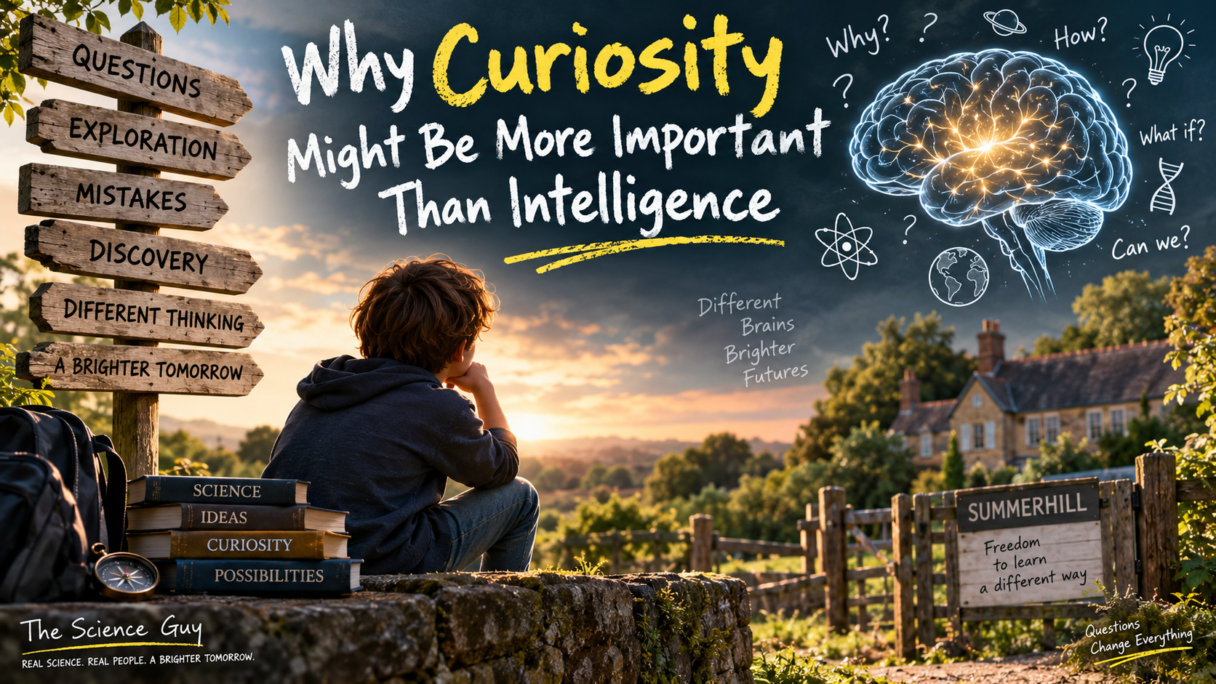
Why Curiosity Might Be More Important Than Intelligence
We have become rather fond of measuring intelligence. Schools measure it through examinations and grades. Employers measure it through qualifications and aptitude tests. Parents worry about whether their children are “bright enough”, while children quietly learn that some classmates are apparently clever and others are not. Adults returning to education often carry the same labels with them, sometimes decades after leaving school. I have met plenty of people who will happily tell you that they are “not academic”, usually with the confidence of someone reporting an established scientific fact rather than a conclusion reached when they were fourteen.
The trouble is that intelligence is not quite as straightforward as we like to imagine. Nor, for that matter, is learning.
One of the things that interests me about science is that it begins with a question rather than an answer. Before there is an experiment, there is usually somebody looking at something and thinking, Why does that happen? Before there is a theory, there is somebody sufficiently curious to wonder whether the explanation everyone has accepted might actually be incomplete. Curiosity is not a decorative extra attached to scientific thinking…it is one of the things that makes scientific thinking possible in the first place.
That raises an interesting question. If curiosity is so fundamental to science, learning and discovery, why have we traditionally been rather bad at encouraging it in education?
The problem with being “clever”
We tend to talk about intelligence as though it were a fixed possession. You either have it or you don’t. Perhaps you are one of the clever ones, or perhaps you are destined to spend your life staring blankly at algebra while somebody at the front of the classroom explains, for the fourth time, why x has suddenly become everyone’s problem.
But intelligence is far more complicated than a single number or a school report.
Human beings possess different strengths. Some are exceptionally good at recognising patterns. Others are brilliant with language, spatial relationships, practical problems, people or abstract ideas. Some can remember enormous quantities of information, while others struggle to retain something they were told five minutes ago but can spend three hours investigating a subject that has captured their interest.
That last distinction matters.
A learner who appears disengaged in one situation can become extraordinarily focused in another. A child who struggles to concentrate on a conventional lesson might spend an afternoon dismantling a bicycle, researching dinosaurs, building something in Minecraft or trying to understand how an engine works. An adult who was told at school that they were not particularly academic might discover decades later that, given the freedom to choose the subject and the reason for learning it, they are actually rather good at it.
This is one reason why I have always been wary of the idea that educational success and intellectual ability are quite the same thing. They aren’t.
The ability to perform well within a particular educational system is certainly useful. It can open doors and provide opportunities, and examinations have their place. But the capacity to learn, investigate, question, adapt and continue when something becomes difficult is considerably larger than the ability to reproduce information under examination conditions.
And that brings us back to curiosity.
Your brain likes a mystery
Curiosity is not simply a personality trait. There is a biological side to it.
When we encounter something we don’t know but believe we might be able to understand, our brains become interested in closing that gap. Research into curiosity suggests that being curious can influence attention, motivation and memory. We become more engaged when there is something we genuinely want to know.
Think about the difference between being told that you must remember something and desperately wanting to know the answer to a question. The first can feel like work. The second can keep you awake.
That distinction is particularly important when we think about education. Information can be presented perfectly and still fail to become meaningful learning if the learner has no reason to engage with it. A teacher can explain something beautifully, a textbook can contain everything required for the examination and a PowerPoint presentation can have been constructed with the sort of dedication normally reserved for national infrastructure projects…and the student’s brain can still quietly decide that none of this is particularly interesting.
Curiosity changes the equation because it creates a reason to pay attention. A question becomes the hook.
Why does the Moon appear to change shape? Why does ice float? Why do we dream? Why does a plane stay in the air? Why does my brain remember the lyrics to a song from 1987 but forget what I went into the kitchen for? That last one may require further investigation.
What Summerhill taught me about questions
My experience at Summerhill gave me an unusual perspective on this.
The educational philosophy associated with Summerhill, founded by A. S. Neill, challenged many of the assumptions surrounding conventional schooling. The school became known for giving children considerable freedom and for treating them as individuals rather than simply as pupils to be managed. Learning was not supposed to be reduced to sitting quietly, obeying instructions and absorbing whatever happened to be placed in front of you.
That does not mean that freedom magically turns every child into Einstein before breakfast. Children are still children. They can be gloriously curious one minute and profoundly interested in doing absolutely nothing the next. Anyone who has spent time around children will recognise that particular scientific phenomenon.
But there is something important in allowing curiosity room to exist.
When a learner is permitted to ask questions, follow interests and discover things for themselves, education can become less about compliance and more about exploration. The learner is no longer simply receiving information from an authority figure. They are participating in the process of finding things out.
That distinction matters enormously.
Science itself works this way. We don’t understand the natural world because somebody handed humanity a sufficiently comprehensive textbook and told us to memorise it. We understand more because generations of curious people refused to accept that the existing explanation was necessarily the final one.
The history of science is, in many respects, a history of people being wonderfully awkward. Someone notices something doesn’t quite make sense. Someone asks an inconvenient question. Someone else says that the question is ridiculous. Eventually somebody performs an experiment and discovers that the supposedly ridiculous question was actually rather good.
Progress has a habit of beginning with somebody asking why.
Different brains, different routes into learning
This becomes particularly relevant when we consider learners who do not fit comfortably into traditional educational structures.
A child with ADHD may experience attention and motivation differently from a child who finds it relatively easy to remain focused on a conventional lesson. An autistic learner may engage deeply with particular subjects while finding other forms of classroom interaction difficult. A dyslexic learner may encounter written information differently from someone who has never struggled with reading. Adults returning to education may have responsibilities, experiences and anxieties that simply weren’t present when they were teenagers.
None of this means that people with additional learning requirements are somehow incapable of learning. It means that the route into learning may be different.
That distinction is important because education has sometimes confused different with deficient. If a learner doesn’t respond well to one particular method, the temptation can be to assume that the learner is the problem. Perhaps we should occasionally consider whether the method deserves a little scrutiny as well.
This isn’t an argument for abandoning standards. It isn’t an argument for telling everyone that anything they do is brilliant simply because they tried, and it certainly isn’t an argument for pretending that learning difficult things should always be easy. Quite the opposite. It is an argument for understanding the learner well enough to find the doorway through which they can enter the subject.
For some people, that doorway might be a diagram. For another, it might be practical experimentation. Someone else may need to talk through an idea. Another learner might need movement, repetition or a particularly interesting question before the subject suddenly becomes meaningful.
There isn’t necessarily one correct route. There are human beings.
The adult learner who thinks they are “not academic”
Perhaps this is where the subject becomes particularly interesting.
Children haven’t yet accumulated quite so much evidence about what they supposedly cannot do. Adults have. We remember the teacher who told us we weren’t very good at something. We remember the examination we failed. We remember sitting at the back of the classroom wondering why everyone else seemed to understand something that appeared to have been written in ancient Greek.
Then we carry those memories into adulthood.
I’m not good at science. I’m rubbish at maths. I’m just not academic.
Sometimes what those statements really mean is, I wasn’t taught this in a way that made sense to me.
That is a very different thing.
The adult brain remains capable of learning. It remains capable of forming new connections, acquiring new knowledge and developing new skills. Experience can even become an advantage because adults bring a lifetime of observations and existing knowledge to whatever they are learning.
An adult learning physics, for example, isn’t approaching the world as a blank sheet of paper. They have already watched objects fall, driven cars, experienced weather, travelled on aircraft, used electricity and probably dropped their phone down the toilet at least once. The science is already happening around them. Education can simply give them the language to understand it.
Curiosity doesn’t care how old you are
Perhaps this is why I like curiosity more than the conventional idea of intelligence.
Intelligence, at least as we commonly discuss it, can sound like something we are given. Curiosity is something we exercise.
A curious child asks why the sky is blue. A curious teenager asks how an aircraft can possibly stay in the air. A curious adult wonders why their heating bill has suddenly developed the financial characteristics of a small mortgage. The questions change, but the underlying impulse doesn’t.
And perhaps that is something education should protect rather than suppress.
Because once curiosity disappears, learning can become little more than the accumulation of facts. Facts are useful, obviously. Science depends upon reliable knowledge. But facts without curiosity can become inert things…stored, reproduced and eventually forgotten.
Curiosity gives knowledge somewhere to go.
It encourages us to connect one idea to another, to test assumptions, to investigate contradictions and to keep looking when the first explanation doesn’t quite satisfy us. It is one of the reasons a scientist continues experimenting, a child continues asking questions and an adult can suddenly become fascinated by a subject they were convinced they had left behind with their school uniform.
Perhaps, then, the question isn’t whether someone is intelligent enough to learn. Perhaps we should be asking whether we have given them something worth being curious about.
Because the person who asks questions is already doing something remarkably important. They are admitting that they don’t know the answer while being sufficiently interested to find out.
That is not the opposite of intelligence.
It may be where intelligence begins.
Book a Free Introductory Session
A relaxed, no-pressure session to see if this approach works for your child.
Leave a Reply