
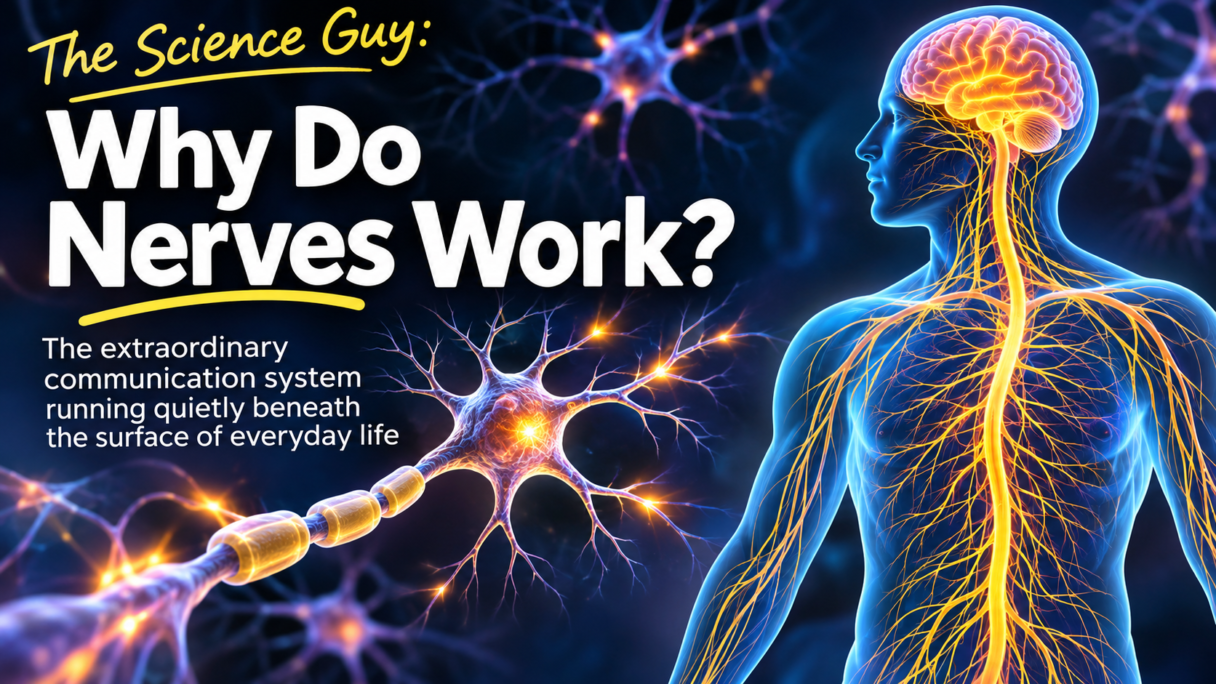
Why Do Nerves Work?
The extraordinary communication system running quietly beneath the surface of everyday life
Imagine reaching for a saucepan on the cooker, only to discover that the handle is considerably hotter than you expected. Your fingers make contact, your hand pulls away and a moment later your brain catches up with what has happened. You might swear, shake your hand and wonder why you didn’t think to use a tea towel in the first place, but something rather remarkable has just taken place inside your body. Information has travelled from your skin, through your nervous system, and triggered a coordinated muscular response in a fraction of a second. You didn’t have to sit down and consider the possibilities, consult an instruction manual or hold a committee meeting with your brain. Your body simply reacted.
We tend to take these things for granted because they happen constantly. We touch, taste, smell, hear, see, walk, breathe and respond to the world around us without giving much thought to the extraordinary biological machinery making it all possible. Yet behind almost every movement, sensation and conscious experience is a communication system so sophisticated that scientists are still discovering more about how it operates. It is called the nervous system, and it is responsible for receiving information, interpreting it and coordinating the responses that keep us functioning. So, what exactly are nerves, how do they work, and how does a collection of specialised biological cells manage to turn an electrical signal into something as complicated as a thought, a movement or a sensation?
Your body has its own communication network
The nervous system is rather like an enormous communications network running throughout the body, although describing it as a collection of wires would be doing it a considerable injustice. At its centre are the brain and spinal cord, which together form what we call the central nervous system. Connected to these are the peripheral nerves, which extend outwards towards the skin, muscles, organs and other tissues. The peripheral nervous system carries information towards the central nervous system, allowing the brain and spinal cord to receive updates about what is happening, while also carrying instructions back out to the body.
Consider what happens when you walk across an uneven surface. Your eyes provide information about the ground ahead, receptors in your muscles and joints help establish where your limbs are positioned, and your brain processes all this information while coordinating the movements needed to keep you upright. Your muscles continually make small adjustments, often without you consciously noticing them. The same system allows you to recognise the warmth of a cup, distinguish between rough and smooth surfaces, or notice that somebody has called your name from another room. The nervous system is constantly gathering information and responding to changes, both inside and outside your body.
It also controls many processes that you probably wouldn’t want to manage manually. Your heart continues beating, your digestive system processes food and your pupils adjust to changing light levels without you having to issue instructions. These activities are regulated through different parts of the nervous system, including the autonomic nervous system, which manages many of the body’s involuntary functions. In other words, while you’re concentrating on reading this article, your nervous system is quietly getting on with a considerable amount of work in the background. It’s rather fortunate, really, because remembering to make your heart beat every few seconds would become terribly inconvenient.
Meet the neurone… the body’s biological messenger
The basic working cell of the nervous system is called a neurone, sometimes spelt neuron. Unlike many ordinary cells, neurones are highly specialised for communication. They are designed to receive information, process incoming signals and transmit messages to other cells. Although their appearance varies depending on their function and location, most neurones share several important structural features.
At one end are branching structures called dendrites, which receive signals from other cells. These connect to the cell body, which contains the nucleus and maintains the neurone. Extending away from the cell body is a long fibre called an axon, which carries electrical signals towards other cells. Some axons are surrounded by a fatty insulating layer known as the myelin sheath. This covering helps electrical impulses travel more quickly and efficiently along the nerve fibre. At the far end, the axon branches into terminals that allow the neurone to communicate with another cell.
The human nervous system contains billions of neurones, forming an extraordinary network of connections. These cells communicate with one another, with muscles and with specialised sensory structures throughout the body. They are not simply biological cables carrying messages from one place to another. They are living cells with membranes, chemical processes and specialised structures that allow them to generate and transmit electrical signals. Understanding how they do this takes us into one of the most interesting areas of biology, where electricity and chemistry work together in ways that are essential to almost everything we experience.
Electricity… but not quite as you might imagine
We often describe nerves as carrying electrical impulses, which is broadly correct, but the electricity involved is rather different from the current flowing through the cables in your home. In a metal wire, electric current is carried by the movement of electrons. In a neurone, electrical signalling depends on the movement of electrically charged particles called ions. Two particularly important examples are sodium ions and potassium ions, which move across the neurone’s cell membrane through specialised protein channels.
When a neurone is resting, there is a difference in electrical charge between the inside and outside of its membrane. This is known as the resting membrane potential. The cell maintains this arrangement through the movement of ions across its membrane, including the work of a specialised structure called the sodium-potassium pump. When a sufficiently strong stimulus arrives, certain channels open and sodium ions move into the cell, changing the electrical charge across the membrane. If the stimulus reaches the necessary threshold, this produces an action potential, an electrical signal that travels along the axon.
As the signal passes, potassium ions move out of the cell, helping to restore the original electrical conditions so the neurone can be ready to transmit another signal. This process happens extremely quickly and can repeat many times as information travels through the nervous system. Where an axon has a myelin sheath, the signal effectively travels between small gaps in the insulation called nodes of Ranvier. This arrangement allows the impulse to travel much faster than it would along an unmyelinated axon.
The interesting thing here is that the body is using chemistry to generate electricity. There are no tiny copper wires running through your arms and legs, no miniature batteries hidden in your fingertips and certainly no little electricians working behind the scenes. Instead, specialised cells use the movement of charged particles to create and transmit signals. It is an elegant biological system, and one that demonstrates just how closely chemistry, physics and biology are connected.
How does a message get from one neurone to another?
You might reasonably imagine that one neurone simply connects directly to the next, rather like two sections of electrical cable joined together. In reality, communication between many neurones involves a tiny gap called a synapse. When an electrical impulse reaches the end of a neurone, it can trigger the release of chemical messengers known as neurotransmitters. These chemicals cross the microscopic gap and attach themselves to specialised receptors on the receiving cell.
Depending on the particular neurotransmitter and receptor involved, the message may encourage the next neurone to generate an electrical impulse, or it may make that less likely. This allows the nervous system to regulate communication rather than simply passing every message along automatically. Some neurotransmitters are involved in movement, others in attention, memory, mood and many other functions. Acetylcholine, for example, plays an important role in communication between motor neurones and skeletal muscles, allowing signals from the nervous system to trigger muscular contraction.
This combination of electrical and chemical communication is particularly important. Electrical impulses carry information along the neurone, while chemical messengers commonly transmit signals across the synapse. It is a system that allows vast networks of cells to communicate, coordinate their activity and respond to changing circumstances. The more we understand about these connections, the clearer it becomes that the nervous system isn’t simply a collection of individual cells passing messages around. It is an interconnected biological network whose behaviour depends on the activity of countless cells working together.
Why does your hand move before you think?
Let’s return to that hot saucepan, because it provides a useful example of how the nervous system protects us. Specialised sensory receptors in your skin detect potentially damaging heat. These receptors trigger electrical signals in sensory neurones, which carry information towards the spinal cord. However, the body doesn’t necessarily wait for the brain to consciously process the information before responding. Instead, a protective response called a reflex action can be coordinated through the spinal cord itself.
In a typical withdrawal reflex, the sensory neurone communicates with other neurones within the spinal cord. These connections activate motor neurones, which carry signals back towards the muscles in your arm and hand. The muscles contract, pulling your hand away from the hot object. Meanwhile, information about the original stimulus is also travelling towards the brain, allowing you to become consciously aware of the pain. The protective movement can therefore begin before you’ve fully registered what has happened.
This pathway is known as a reflex arc, and it demonstrates how the nervous system can produce a rapid response without requiring conscious decision-making. Reflexes are important because they help protect the body from potential injury. They aren’t all controlled by the spinal cord, either. Some, such as the automatic adjustment of your pupils in response to changes in light, involve other parts of the nervous system.
There is a useful distinction here between a reflex and an ordinary reaction. If somebody throws you a ball, you see it approaching, process the information and decide to catch it. That involves sensory input, processing and a voluntary motor response. A withdrawal reflex, on the other hand, is an automatic protective response that can be organised through the spinal cord. Both demonstrate the remarkable speed and coordination of the nervous system, but they work in slightly different ways.
Your nerves do considerably more than make you move
Movement and reflexes are only part of the story. The nervous system is also responsible for allowing us to experience the world through our senses. Sensory neurones carry information from specialised receptors that detect light, sound, pressure, temperature, chemicals and changes in body position. This information is processed by different regions of the brain, allowing us to recognise what we are seeing, hear music, identify familiar smells or feel the difference between a gentle touch and something painful.
Then there is the autonomic nervous system, which regulates many of the processes that keep us alive without requiring conscious instructions. It has two principal divisions, known as the sympathetic and parasympathetic nervous systems. The sympathetic division prepares the body for action, particularly during stressful or threatening situations. Heart rate increases, breathing changes and energy becomes more readily available. This is often associated with the familiar fight-or-flight response.
The parasympathetic division generally supports rest, digestion and recovery, helping the body return towards a calmer state after periods of activity. It encourages processes such as digestion and supports the body’s ability to conserve energy. Neither division is inherently better than the other. Both are essential, and the body depends on their ability to work together to maintain a relatively stable internal environment.
This is another example of homeostasis, the biological process through which the body maintains conditions within a range that allows cells and organs to function properly. Temperature, blood glucose, water balance and other internal conditions all need to be regulated. The nervous system plays an important role in this process, working alongside the endocrine system, which uses hormones to coordinate many of the body’s longer-term responses.
A little experiment… how quick are your reactions?
You don’t need a laboratory full of expensive equipment to investigate the nervous system. A simple reaction-time experiment using an ordinary ruler can demonstrate how quickly your body detects information and responds to it. Ask somebody to hold a ruler vertically, with the zero mark level with your thumb and forefinger. Without warning, they should release it, and you should catch it as quickly as possible. Record the distance the ruler falls before you catch it, then repeat the experiment several times to see whether your results change.
The shorter the distance, the quicker your measured reaction. You can also compare your dominant and non-dominant hands, or repeat the experiment when you are feeling tired and compare the results. What you’re measuring isn’t a pure reflex like withdrawing your hand from something hot. It is a voluntary reaction involving sensory processing, decision-making and motor control. Nevertheless, it provides a useful demonstration of how information travels through your nervous system and how several stages of biological communication must work together before a movement takes place.
There are plenty of variables that can influence the results, including concentration, fatigue, practice and the complexity of the stimulus. If you want to make the experiment a little more scientific, record several attempts rather than relying on one result, calculate the average and compare the figures. You could even investigate whether repeated practice improves your reaction time. Just be prepared for the possibility that somebody will take the results rather more seriously than the experiment warrants. Science has occasionally been known to bring out the competitive streak in otherwise perfectly reasonable people.
The science behind the ordinary
The nervous system is one of the most extraordinary biological systems in the human body, yet most of us rarely give it a second thought. We simply reach for a cup, walk across a room, feel the warmth of the sun or pull our hand away from something hot. Behind these apparently ordinary activities are billions of specialised cells communicating through electrical and chemical signals, coordinating movements, interpreting sensations and maintaining the conditions necessary for life.
We often talk about technology as though sophisticated communication networks are a uniquely human achievement. We build faster computers, develop increasingly complicated electronic systems and find new ways of exchanging information across the world. Yet inside our own bodies is a biological communication network that has developed through millions of years of evolution. It is not perfect, and it is certainly not immune to damage or malfunction, but its ability to process information and coordinate activity remains extraordinary.
Perhaps that is one of the most interesting things about biology. We tend to imagine science as something happening in laboratories, universities or research facilities, involving complicated equipment and people wearing white coats. In reality, some of the most fascinating scientific processes are taking place right in front of us, and often inside us, every minute of every day. The next time you touch something hot, stumble slightly and regain your balance, or automatically turn towards somebody calling your name, spare a thought for the remarkable network of cells making it happen.
Science doesn’t always require a telescope, a microscope or a complicated experiment. Sometimes all it takes is an ordinary moment and the willingness to ask a question about what just happened. And if that question leads you to discover that your body is effectively running an electrical and chemical communications network without charging you a monthly subscription, that’s not a bad day’s learning.
Science Guy: Why?
Because understanding the world begins with asking questions about the things we experience every day.
Book a Free Introductory Session
A relaxed, no-pressure session to see if this approach works for your child.
Leave a Reply