
Why Do Onions Make Us Cry?
The Chemistry Behind a Kitchen Mystery
An everyday question that reveals just how clever nature can be.
There are few kitchen experiences quite as humbling as preparing a simple meal while an onion gradually reduces you to a sniffling, red-eyed wreck. You begin with good intentions, a chopping board and a sharp knife. A few minutes later, you are blinking furiously, tears are running down your face, and anyone watching might reasonably assume that you have just received some devastating personal news.
Yet the onion, despite appearances, has done nothing particularly personal to you. It is simply responding to damage in the way nature has equipped it to respond.
That raises an interesting question. Why should cutting an onion make us cry at all? And how does a humble vegetable manage to turn an otherwise perfectly ordinary cooking exercise into an impromptu emotional performance?
As with so many everyday experiences, the answer becomes considerably more interesting when we stop accepting what happens and start asking why.
What Happens When We Cut an Onion?
An onion is a living plant organ, and like other living things, it has ways of protecting itself. It cannot run away from danger, bite an approaching predator or lodge a formal complaint with the local authorities, so it relies on chemistry instead.
Inside an intact onion, different chemical substances are kept largely separate within its cells. When we cut through the onion with a knife, we damage those cells and allow substances that would normally remain apart to mix and react.
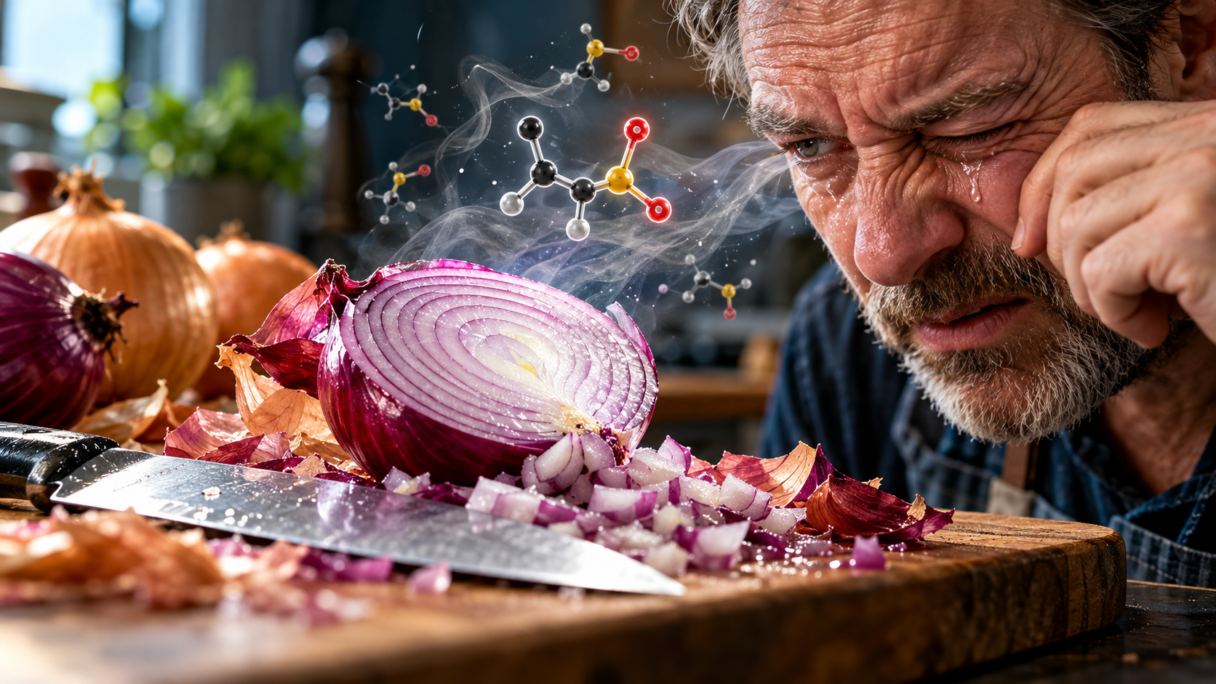
One consequence is the production of a volatile chemical compound called propanethial S-oxide. The word volatile is important here because it means the substance can readily evaporate and enter the air. Once released from the freshly cut onion, it can travel towards our eyes.
When this compound reaches the moist surface of the eyes, it irritates the sensory nerve endings there. These nerve endings send signals to the brain, which interprets the irritation as something that needs dealing with.
The result is a familiar biological response: your eyes begin producing tears.
Your body is not being sentimental about the onion. It is attempting to protect the delicate surface of your eyes by diluting and washing away the irritant. Unfortunately, the process can be rather enthusiastic, particularly when you are preparing several onions for a large meal.
A Little Chemistry Goes a Long Way
The fascinating part of this process is that the tear-inducing chemical is not simply sitting inside the onion, waiting for somebody to release it. Its formation involves a chain of chemical reactions.
When onion cells are damaged, an enzyme called alliinase acts on certain sulphur-containing compounds. This produces intermediate substances that can undergo further reactions, eventually leading to the formation of the irritating gas.
Scientists have also identified an enzyme called lachrymatory-factor synthase, which helps direct the chemical process towards producing propanethial S-oxide. The discovery of this enzyme helped explain why onions produce this particular compound rather than simply releasing a random assortment of sulphur chemicals.
It is a wonderful example of how biology and chemistry overlap. The onion is a biological organism, but its response to damage depends on chemical reactions taking place inside its cells.
There is no little control room inside the onion, complete with flashing warning lights and a miniature officer shouting, “Deploy the eye-watering agent!” Instead, the plant’s cellular machinery sets off a sequence of reactions when its tissues are damaged.
The outcome is still remarkably effective, even if the onion has never once considered the inconvenience it causes to the person preparing dinner.
Why Would a Plant Need Such a Defence?
To understand the purpose of this chemical reaction, we need to look beyond the kitchen.
Plants face a constant challenge. They need to survive in an environment populated by animals, insects, fungi and other organisms that may eat them, damage them or compete with them for resources. Unlike animals, most plants cannot escape by moving somewhere safer.
Instead, plants have evolved a remarkable range of physical and chemical defences.
Some produce bitter-tasting compounds that discourage animals from eating them. Others contain substances that are toxic to particular insects or microorganisms. Certain plants have thorns or irritating hairs, while others release chemicals that interfere with the growth or behaviour of potential attackers.
The onion’s chemistry is part of this broader story. Its sulphur-containing compounds contribute to its characteristic flavour and aroma, and some of its chemical products can help deter organisms that damage the plant.
We should be careful not to assume that every compound has a single purpose or that an onion has consciously developed a strategy. Evolution works through variation and natural selection over many generations. Traits that improve survival or reproduction can become more common in a population.
Over time, chemical defences can become highly specialised.
The onion is therefore not simply a food waiting patiently in the vegetable drawer. It is the product of an evolutionary history in which chemistry has helped a plant survive.
That is quite a lot to discover from something you might otherwise throw into a frying pan without giving it a second thought.
Why Do Some Onions Make Us Cry More Than Others?
Anyone who has chopped different varieties of onion may have noticed that some seem considerably more irritating than others. There are good scientific reasons for this variation.
Different onion varieties can contain different concentrations of sulphur-containing precursors, and the amount of tear-inducing compound produced depends on several factors, including the onion’s variety, growing conditions, storage and the way it is cut.
The knife matters, too. A blunt knife tends to crush and damage more tissue than a sharp one, potentially releasing more of the substances involved in the chemical reaction. A sharp knife cannot eliminate the problem, but it can reduce unnecessary cell damage.
The speed at which the irritating compound reaches your eyes also matters. Air movement, the distance between the chopping board and your face, and the temperature of the onion can all influence the experience.
This is why advice about putting onions in the refrigerator before cutting them can sometimes help. Cooling an onion slows many chemical reactions and reduces the rate at which volatile substances escape into the air. It may make chopping more comfortable, although it is not a guaranteed solution.
Another option is to improve ventilation, allowing the irritating compound to disperse rather than accumulate around your face. Some people find that wearing properly fitting protective goggles helps by reducing the exposure of their eyes to the airborne irritant.
The important point is that these methods work by changing the conditions surrounding the reaction or reducing our exposure to its products. They do not magically persuade the onion to behave itself.
Science rarely offers quite that level of domestic authority.
Could Scientists Create an Onion That Doesn’t Make Us Cry?
Here is where the story becomes even more interesting.
For years, scientists have investigated whether onions could be developed that produce fewer tear-inducing compounds without losing the flavour and qualities people value. This is not merely a matter of finding a more convenient vegetable. It is an opportunity to understand the biochemical pathways responsible for flavour, aroma and irritation.
Researchers developed a low-lachrymatory-factor onion using approaches that included suppressing the activity of the enzyme responsible for producing the tear-inducing compound. The work demonstrated that changing a specific part of a plant’s biochemical machinery could reduce its irritating effect.
This is a useful example of how scientific understanding can lead to practical applications. Rather than simply accepting that onions make people cry, researchers asked which chemical process was responsible and whether it could be altered.
The same general approach is used across biology, agriculture and medicine. Scientists investigate how living systems work, identify the mechanisms involved and explore whether those mechanisms can be modified to achieve a particular result.
Of course, changing one biochemical pathway can have consequences elsewhere. A compound involved in irritation may also be connected to other aspects of a plant’s chemistry, so researchers must consider flavour, growth, disease resistance and other characteristics.
That is why science is not simply a matter of finding a problem and switching off the offending mechanism. Living systems are interconnected, and changing one part can influence another.
Nevertheless, the onion offers a useful demonstration of how understanding the science behind an everyday nuisance can open the door to new possibilities.
What Does an Onion Teach Us About Science?
Perhaps the most valuable lesson here has little to do with onions themselves.
We encounter countless things every day without giving them much thought. Water boils, bread rises, soap removes grease, metal objects become hot in sunlight, and ice floats in a glass of water. We become familiar with these experiences, and familiarity can easily be mistaken for understanding.
Knowing that something happens is not quite the same as understanding why it happens.
A student might learn that onions produce a chemical that irritates the eyes and remember the answer perfectly well for an examination. That knowledge has value, but the deeper learning begins when further questions appear.
Why does the onion produce the chemical? How does the chemical form? What happens when it reaches the eye? Why do different onions behave differently? Could the process be changed?
Each answer creates opportunities for another question.
This is how science develops, and it is also how curiosity can turn an ordinary observation into a genuine learning experience. We begin with something familiar, investigate the evidence, build an explanation and then discover that the explanation connects to much bigger ideas.
In this case, we have travelled from a kitchen chopping board to cellular biology, chemical reactions, sensory nerves, evolution and agricultural research.
Not bad for a vegetable.
It is also a reminder that science does not belong exclusively to laboratories, universities or people wearing white coats. You do not need expensive equipment or a shelf full of textbooks to begin asking worthwhile scientific questions. Often, you simply need to notice something that interests you and resist the temptation to dismiss it as ordinary.
The Next Time You Cut an Onion…
The next time you prepare an onion, take a moment to consider what is happening beneath the surface. A knife damages the cells, enzymes help trigger chemical reactions, a volatile compound enters the air, and your nervous system responds by activating the production of tears.
It is an elegant sequence of events, even if the experience itself is less than elegant.
More importantly, it demonstrates something that I believe should sit at the heart of science education. Understanding begins when we become curious enough to look beyond the obvious answer.
For some learners, particularly those who have struggled with traditional classroom approaches, this can make a real difference. Science becomes less about memorising unfamiliar terminology and more about connecting ideas to experiences they already understand.
That is one reason I believe lessons should make room for questions, discussion and exploration. Different learners find different routes into a subject, and a familiar everyday example can sometimes open a door that a page of definitions leaves firmly shut.
Whether you are studying GCSE Science, returning to education after many years, supporting a young person with their learning or simply interested in how the world works, there is always another question worth asking.
And if that question happens to involve an onion, you might want to keep a tissue handy.
Science can be enlightening, but occasionally it leaves you in tears.
James Coulter
The Science Guy
Science begins with a question. Understanding grows when we follow it.
Book a Free Introductory Session
A relaxed, no-pressure session to see if this approach works for your child.
Leave a Reply