
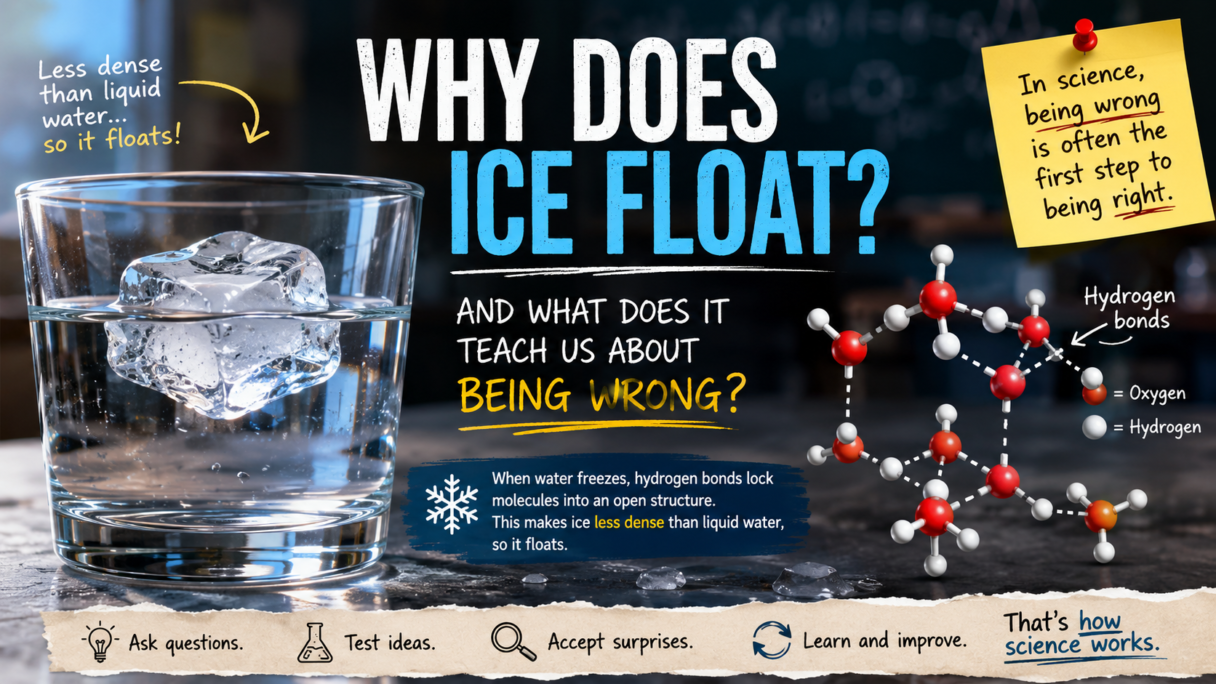
Why Does Ice Float? And What Does It Teach Us About Being Wrong?
Take an ice cube, drop it into a glass of water and watch what happens.
It floats.
Most of us have seen it thousands of times without giving it much thought. We put ice in a drink, the ice bobs around on the surface, eventually disappears and, unless we’re particularly short of things to worry about, we carry on with our day.
But ask a child why it floats and you have suddenly opened the door to some rather good science.
The obvious answer is that ice is less dense than liquid water. That is correct, but it is also only the beginning of the interesting bit. The better question is not simply what happens? but why does it happen?
That distinction matters, particularly when we are talking about learning science.
The slightly odd behaviour of water
Most substances become denser when they change from a liquid into a solid. The particles become more tightly packed as the material settles into its solid structure.
Water does something rather unusual.
When water freezes, the molecules arrange themselves into a more open structure because of the way hydrogen bonds hold the molecules in place. That structure takes up more space than the same amount of liquid water, which means the resulting ice has a lower density.
And because something less dense than the liquid surrounding it will float, the ice cube sits on the surface.
It sounds simple once we know the answer, which is one of the great tricks of science. We are very good at looking backwards at an explanation and thinking it was obvious all along.
It wasn’t.
The interesting science begins when somebody asks the question in the first place.
What if the answer we have is wrong?
This is where ice becomes rather more useful than it first appears.
Science is often presented to pupils as though it is a great warehouse of established facts. Learn this definition. Remember this equation. Label this diagram. State this process. Give the correct answer.
There is certainly a place for knowledge. You cannot do much with science if you do not know any science in the first place. But science itself is not simply the memorisation of correct answers.
Science is a process of asking questions, forming explanations, testing them against evidence and being prepared to change your mind when the evidence doesn’t agree with you.
That last part is rather important.
Being wrong is not necessarily a failure of science. Sometimes discovering that you are wrong is precisely how science moves forward.
A scientist who expects every experiment to confirm what they already believe is not really testing an idea. They are looking for reassurance.
The useful question after an unexpected result is often, “Why did that happen?”
That is a very different attitude from simply marking the answer wrong and moving on.
The difference between knowing and understanding
Imagine a pupil is asked why ice floats.
They might learn that the answer is “because ice is less dense than liquid water” and remember it perfectly well for an examination.
That may earn them the mark.
But suppose another pupil asks why ice is less dense. They want to know what happens to the molecules, why hydrogen bonding matters and why freezing causes water to occupy more space.
That pupil has moved beyond remembering an answer and started investigating the explanation behind it.
Neither pupil is necessarily more intelligent than the other. They have simply approached the question differently.
And this is one of the things I find particularly interesting about teaching science. A pupil who keeps asking why can sometimes appear to be making life unnecessarily complicated.
In reality, they may be doing exactly what we hope scientists will do.
The strange thing about an ice cube
There is another reason this particular question is worth asking.
The fact that ice floats is not merely a curiosity that makes your drink look more interesting. It has enormous consequences for life on Earth.
If ice were denser than liquid water, it would sink.
That would mean that when the surface of a lake or pond began to freeze, the ice would fall towards the bottom. More water would freeze, that ice would sink again, and eventually bodies of water could freeze from the bottom upwards.
The consequences for aquatic life would be profound.
Instead, because ice floats, the layer of ice remains at the surface. It can act as an insulating barrier, slowing the loss of heat from the water beneath it and helping liquid water remain available for life.
So that little ice cube floating in your glass is connected to something considerably larger.
A seemingly insignificant property of water has consequences for ecosystems, climate and the conditions that allow life to exist.
That is the sort of connection that makes science fascinating.
Nature doesn’t care about the mark scheme
One of the challenges of education is that examinations necessarily reduce complicated ideas into questions that can be marked consistently.
That is understandable. Someone has to mark millions of examination papers, and I doubt anyone wants an examiner sitting at home in June muttering, “Well, technically this answer demonstrates an interesting alternative interpretation of thermodynamic behaviour… give the lad fourteen marks and a biscuit.”
But real science is messier.
Experiments don’t always behave as expected. Measurements can be imperfect. Hypotheses can fail. Results can contradict predictions. Sometimes the thing you thought you understood turns out to contain another question hiding underneath it.
That is not a weakness of science.
It is science.
The history of scientific progress is full of ideas that were challenged, modified or abandoned because evidence got in the way.
That is why one of the most valuable habits we can encourage in a young scientist is not simply the ability to produce the correct answer, but the willingness to ask what happens when the answer doesn’t make sense.
“I don’t know” is a perfectly respectable scientific answer
There is something else worth remembering here.
Children are naturally quite comfortable with saying, “I don’t know.”
Adults, on the other hand, have a remarkable tendency to become uncomfortable when they don’t know something.
We sometimes seem to believe that admitting ignorance makes us look less intelligent, when in science the opposite can be true. Recognising that you don’t know something is often the beginning of finding out.
A good scientific question can start with three very ordinary words:
“I don’t know.”
Followed by:
“Let’s find out.”
That is curiosity in its simplest form.
So what does an ice cube teach us?
It teaches us that the world is full of things we take for granted.
It teaches us that an answer can be correct while still being incomplete.
It teaches us that asking another question is often more valuable than simply memorising the first answer.
It teaches us that unexpected behaviour is worth investigating rather than dismissing.
And perhaps most importantly, it reminds us that being wrong is not necessarily the opposite of learning.
Sometimes being wrong is the mechanism by which learning happens.
The next time you drop an ice cube into a glass and watch it float, you might therefore spare it a second glance.
Not because there is anything particularly exciting about an ice cube floating in water.
But because underneath that ordinary little observation is a rather extraordinary lesson about molecules, density, life on Earth and the way human beings discover what they don’t yet understand.
And that, ultimately, is what I hope science education can preserve.
Not simply the ability to remember that ice floats, but the curiosity to ask why.
Book a Free Introductory Session
A relaxed, no-pressure session to see if this approach works for your child.
Leave a Reply