
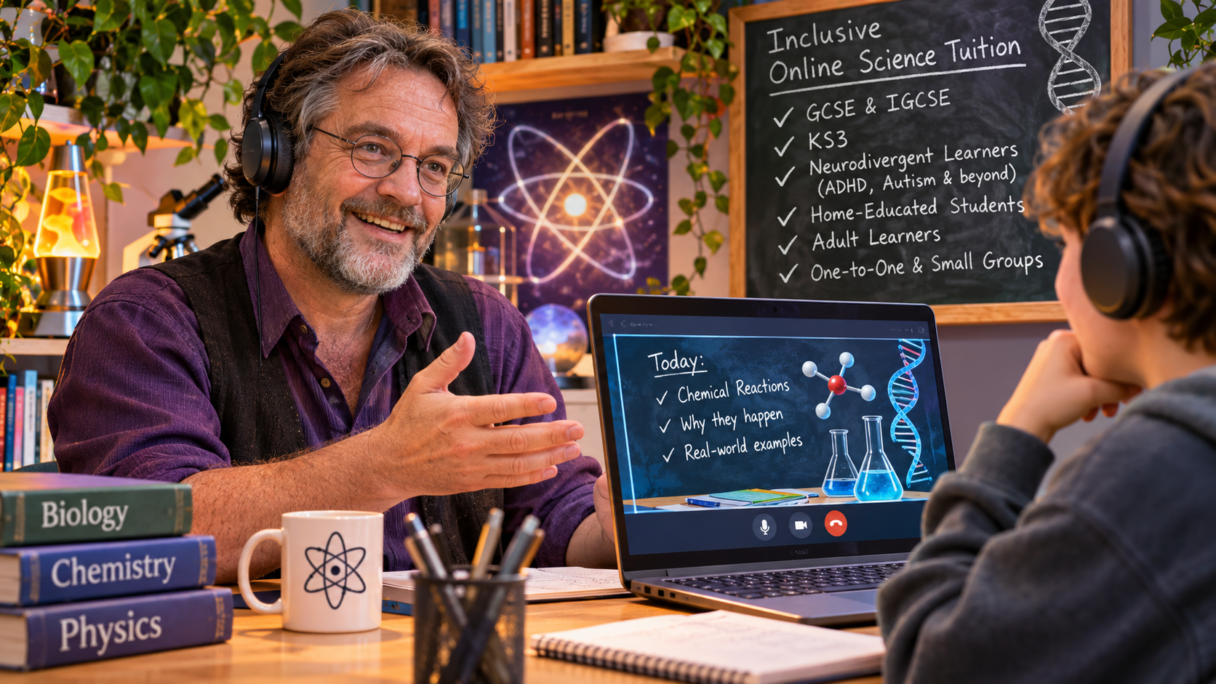
You Don’t Have to Fit the Classroom to Learn Science
Different minds. Different journeys. One shared capacity to learn.
We have become rather accustomed to the idea that education follows a particular pattern. Children go to school, follow a timetable, study a collection of subjects, sit examinations and eventually move on to the next stage of life. For many, this works perfectly well. They enjoy the structure, respond to the teaching methods and find their feet within the conventional education system.
But what happens when it doesn’t work quite so well?
What happens when a child is perfectly capable of understanding complicated ideas but struggles to sit still, concentrate for extended periods, process information in a busy classroom or demonstrate what they know under examination conditions? What happens when an autistic student finds the conventional classroom overwhelming, or someone with ADHD struggles with a teaching approach that expects them to absorb information in precisely the same way as everybody else?
And what about the adult who left school decades ago, perhaps believing that science simply wasn’t for them, but now finds themselves wanting to return to education, gain qualifications or pursue an entirely different career?
These are questions worth asking because education should be about developing potential, not measuring how successfully somebody conforms to a particular method of teaching.
I believe science should be accessible to everyone. Not just those who find examinations straightforward, not just those who thrive in traditional classrooms and certainly not just those who have always been told they are naturally academic.
Learning should be an opportunity, not an obstacle course.
The problem isn’t always the learner
Over the years, we have developed a rather peculiar habit of looking at educational difficulties through the eyes of the institution rather than the individual.
A student who struggles to concentrate is described as inattentive. Someone who needs additional time to process information may be considered slow. A child who asks endless questions can be regarded as disruptive, while someone who finds conventional classroom expectations uncomfortable may become labelled as difficult.
Yet, when we stop for a moment and look beyond those descriptions, we might discover something rather different.
Perhaps that student isn’t struggling with science at all. Perhaps they simply aren’t being given the opportunity to engage with it in a way that makes sense to them.
This distinction matters enormously.
A student with ADHD might have an extraordinary capacity for curiosity and intense concentration when a subject captures their interest, yet struggle with repetitive tasks or lengthy explanations. An autistic learner might have a wonderfully analytical approach to scientific concepts but find unpredictable environments, sensory distractions or changes in routine difficult to manage.
Neither situation suggests an inability to learn.
It suggests that we need to understand the learner before deciding how best to teach them.
Neurodiversity is not a problem to be corrected. It describes the natural variation in how human brains process information, experience the world and approach learning. That variation can bring different strengths, different challenges and different educational requirements.
There is no single teaching method that will work equally well for everybody, and pretending otherwise does nobody any favours.
Different minds need different approaches
One of the most important things I have learned throughout my teaching career is that two students can sit through exactly the same lesson and come away with entirely different experiences.
One might understand everything immediately. Another might need to see the information represented visually. A third might benefit from talking through the subject, asking questions and connecting the information to something they already understand.
Some learners thrive on structure and clearly defined steps. Others need greater flexibility, opportunities to explore their interests and the freedom to approach a subject from a slightly different direction.
For autistic and ADHD learners in particular, understanding these differences can make an enormous difference to the learning experience.
A calm environment, predictable lesson structure, manageable sections of information and opportunities to take breaks can help reduce unnecessary pressure. Visual resources, interactive tools, practical examples and interest-led explanations can make difficult concepts considerably more accessible.
It is also important to recognise that neurodivergent learners are not all the same. Autism and ADHD are not interchangeable experiences, and there is no universal formula for supporting either. What works beautifully for one student may not work particularly well for another.
That is why I believe teaching needs to be responsive.
Rather than expecting every student to adapt themselves to the lesson, I want to understand how that individual learns and make the lesson work around them wherever possible.
Importantly, this isn’t something reserved exclusively for students with a diagnosis. Every learner benefits from being understood as an individual.
What more than ten years at Summerhill taught me
My own approach to education has been shaped considerably by my time teaching at Summerhill School in Suffolk.
For more than a decade, I worked within an educational environment influenced by the philosophy of A.S. Neill, whose approach to education challenged many of the assumptions traditionally associated with schooling.
Summerhill is internationally recognised for its democratic, child-centred philosophy, placing considerable importance on individual freedom, responsibility and the development of the whole person.
It is an environment that encourages us to question some fairly fundamental assumptions about education. Must every child learn in precisely the same way? Does sitting quietly in a classroom necessarily mean somebody is learning? Should the interests and curiosity of the student have a greater role in determining the educational experience?
These are not simply philosophical questions. They have practical implications for how we teach.
My experience at Summerhill reinforced something that I continue to carry into my work today: learning is much more effective when students feel comfortable, respected and genuinely involved in the process.
Children and young people are not empty containers waiting to be filled with information. They arrive with interests, experiences, questions, abilities and individual personalities. Recognising those things is an important part of being an effective teacher.
Today, alongside my teaching, I am Director of A.S. Neill Summerhill CIC, helping to promote and share progressive educational principles more widely.
That experience continues to influence the way I approach online tuition. It has taught me that education doesn’t have to be rigid to be effective, and that giving learners a greater sense of ownership over their education can help them develop both confidence and independence.
Science doesn’t have an age limit
One of the things I particularly enjoy about teaching is the opportunity to work with people at very different stages of their lives.
We often associate education with childhood and adolescence, as though learning is something that belongs exclusively to the young. Once we have left school, gained employment and settled into adult life, returning to formal education can seem like an unusual undertaking.
But why should it?
Perhaps someone wants to gain GCSE Science qualifications to open up opportunities in nursing or healthcare. Perhaps they need an Access to Higher Education qualification before progressing to university. Maybe they are considering a career change, looking to improve their employment prospects or simply want to revisit a subject they never properly understood when they were younger.
Some adults return to education because they finally have the opportunity to pursue something that interested them years ago. Others may have discovered later in life that ADHD, autism, dyslexia or other learning differences help explain why their earlier educational experiences were difficult.
Whatever the circumstances, returning to education should not be an intimidating experience.
There is no reason why an adult learner should feel embarrassed about asking questions, needing additional explanations or starting again with the fundamentals.
In fact, some of the most interesting learning experiences happen when people bring their wider life experiences into the subject. Adults often approach science with questions informed by their work, families, interests and everyday observations. Those experiences can provide excellent starting points for understanding scientific principles.
Whether you are sixteen or sixty, the opportunity to learn remains exactly that… an opportunity.
I provide online science tuition for adult learners as well as younger students, with lessons designed around individual goals, existing knowledge and preferred learning approaches.
You can find out more on my Science Tuition for Adult Learners page.
Bringing science into the online classroom
Online education has opened up some genuinely interesting possibilities.
For many years, people associated learning with a physical classroom, a teacher standing at the front and students following a lesson together. Technology has changed that landscape considerably, and online tuition now offers opportunities for personalised learning that would have been much harder to organise in traditional settings.
My online teaching allows me to work with students in different locations, including home-educated learners and families who may not have access to suitable specialist tuition locally.
I use interactive online teaching tools, screen sharing, digital resources and visual explanations to make lessons engaging and accessible. Where appropriate, lesson recordings can also be made available on request, giving students an opportunity to revisit material afterwards.
However, technology is only part of the picture.
The most important element remains the relationship between teacher and learner.
I offer individual one-to-one tuition as well as small-group sessions, allowing students to benefit from different learning arrangements depending on their circumstances and preferences.
One-to-one lessons provide the opportunity to concentrate entirely on an individual’s requirements. We can work through difficult topics, revisit areas of uncertainty, prepare for examinations or simply develop a stronger understanding of the subject.
Small-group tuition offers a different experience, allowing students to learn alongside others, share ideas and discuss scientific concepts in a supportive environment.
Both approaches have their advantages, and the right choice depends on the individual.
My teaching covers Biology, Chemistry and Physics at KS3 and GCSE level, including support for the major UK examination boards and Cambridge International IGCSE.
For students preparing for examinations, I also provide support with examination technique, revision planning, understanding mark schemes and developing the confidence to demonstrate what they know.
Because understanding a subject and successfully communicating that understanding in an examination are not always the same thing.
More than simply learning the syllabus
Of course, education is about considerably more than remembering scientific facts and reproducing them in an examination.
Science teaches us how to question the world around us, examine evidence, recognise patterns and develop an understanding of why things happen.
It encourages curiosity and critical thinking, two abilities that are useful regardless of the career path somebody eventually chooses.
I also recognise that students sometimes need support beyond the immediate subject they are studying.
Choosing future qualifications, considering college or university applications, exploring career opportunities and understanding possible progression routes can all feel rather daunting, particularly for young people who are still discovering their interests and strengths.
Alongside science tuition, I offer examination coaching, study skills support, careers guidance, personal statement assistance and college application support.
For some students, this additional guidance can be just as valuable as the academic teaching itself.
My aim is to help learners develop the confidence and understanding they need to make informed decisions about their education and their future.
There is no single route through education, and there is certainly no reason why everybody should be expected to follow precisely the same path.
What does working with me actually look like?
I appreciate that choosing an online tutor is an important decision, particularly for parents looking for someone who understands their child’s individual needs.
It is also important for adult learners to feel comfortable with the person supporting them.
My approach begins with understanding what you are looking for, what you hope to achieve and what kind of support might be most useful.
I hold Qualified Teacher Status, have an enhanced DBS check and safeguarding training, and bring extensive teaching experience across different educational settings.
My academic background includes a degree in Forensic Science, an MSc in Biology and an MPhil in Chemical Ecology. I have also taught across a broad range of science subjects and age groups, including A-level and BTEC Science.
I now teach online full-time, working with students internationally, including those preparing for Cambridge IGCSE and the main UK GCSE examination boards.
Lessons are delivered online through MeritHub, using interactive teaching tools and resources to support the learning experience.
I offer one-to-one sessions and small-group tuition for between two and six students, with groups arranged around suitable learning levels and needs.
For families and prospective students who would like to find out more, I offer a free introductory discovery session. It is an opportunity to discuss individual requirements, ask questions and decide whether my approach feels like the right fit.
There is no obligation to continue.
I would much rather establish that we are a good match from the outset than promise something that may not suit a particular learner.
Learning should open doors, not close them
I sometimes wonder how many people have spent years believing they weren’t particularly good at a subject simply because their experience of being taught it wasn’t especially positive.
Perhaps they were never given enough time to understand the fundamentals. Perhaps they were uncomfortable asking questions in front of other students. Perhaps the teaching method simply didn’t connect with the way they processed information.
And perhaps, somewhere along the way, they began to believe that the difficulty belonged to them.
That is one of the things I would like to challenge.
Being unable to understand something immediately doesn’t mean you lack the ability to understand it. Needing a different explanation doesn’t make you a difficult student. Having a different learning style doesn’t mean you are somehow less capable than somebody sitting beside you.
Sometimes, the difference between struggling with a subject and enjoying it is simply finding the right person to help you make sense of it.
I want students to feel comfortable asking questions, exploring ideas, making mistakes and discovering things for themselves. I want them to develop confidence in their abilities rather than become preoccupied with what they think they cannot do.
And I want science to be something they can genuinely enjoy, whether they are preparing for GCSE examinations, returning to education as an adult or simply trying to understand a little more about the world around them.
Because learning isn’t a competition, and it certainly doesn’t come with an age limit.
You don’t have to fit a particular mould to become a successful learner.
You simply need the opportunity, the encouragement and an approach to teaching that recognises you as an individual.
Science is for everyone. The important thing is finding a way to make it accessible to you.
Interested in learning more?
Whether you’re a parent looking for supportive science tuition for your child, a home-educating family, a neurodivergent learner or an adult considering returning to education, I’d be delighted to hear from you.
I offer a free, no-obligation introductory session so we can discuss your requirements and explore how personalised online science tuition might help.
Subjects: Biology, Chemistry and Physics.
Levels: KS3, GCSE and Cambridge IGCSE.
Learning options: Individual one-to-one tuition and small-group online sessions.
Additional support: Examination preparation, revision techniques, study skills, careers guidance and educational progression.
Visit The Science Guy to find out more or arrange your free introductory session.
Book a Free Introductory Session
A relaxed, no-pressure session to see if this approach works for your child.
James Coulter
The Science Guy
Leave a Reply